

What is a company brain?
A company brain is shared knowledge, built from a company's documents, conversations and tools, that people and AI agents can ask, with answers that cite their sources and keep each person's permissions intact. HeyBrain is one way to build one: it connects your sources once and answers in the app and inside AI tools such as Claude, Cursor and Codex.
- It answers from your own sources and shows where each answer came from.
- Nobody has to rewrite knowledge into a new system first, which is what sets it apart from a wiki.
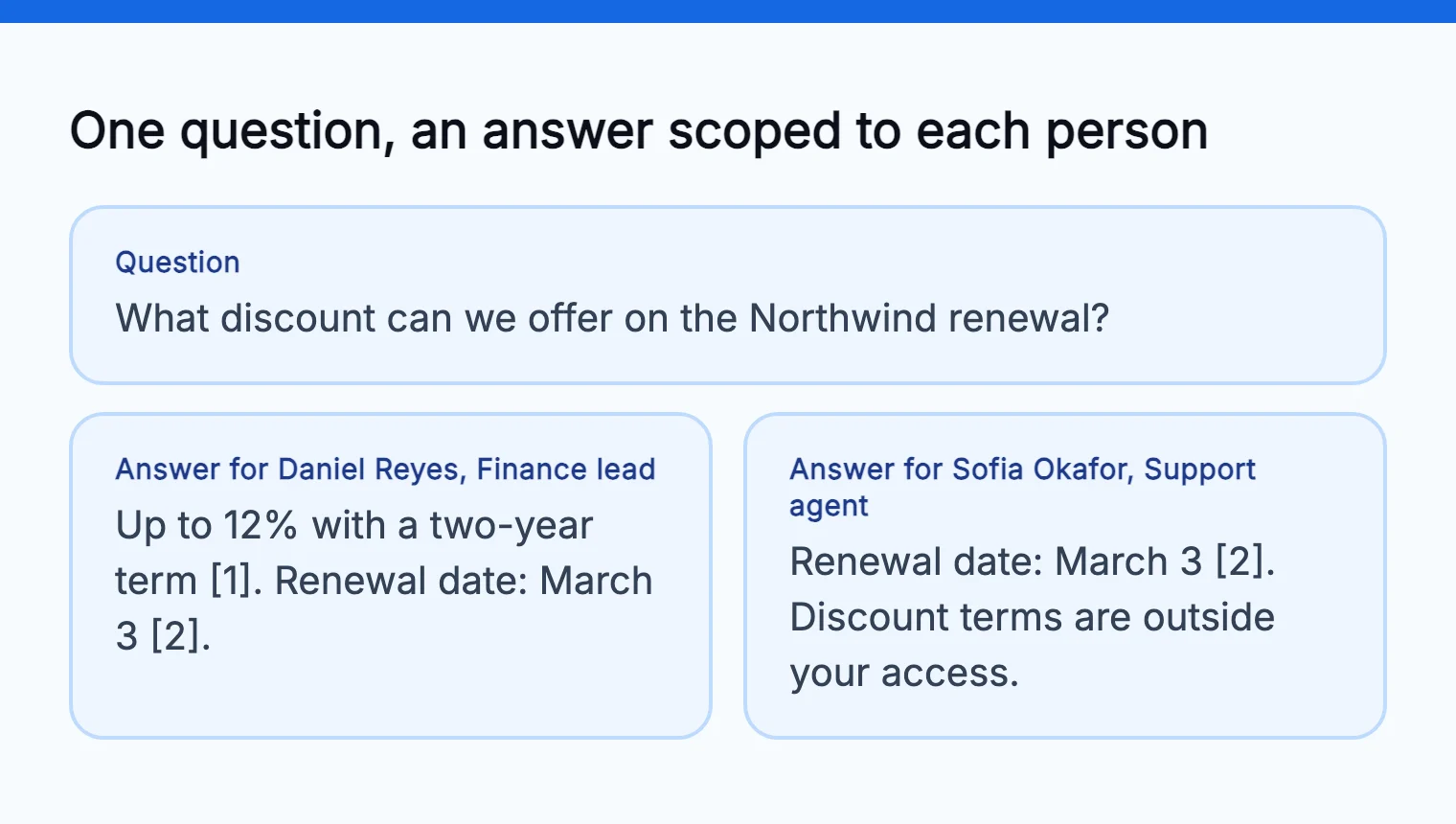
- Permissions travel with the answer, so two people can ask the same question and get different, correct answers.
- It matters now because every AI tool otherwise starts from zero and keeps its own separate memory.
- A good one connects your sources, respects access, keeps a record of who asked what and works in the AI tools people already use.
Contents


Company brain
Meaning, parts and examples
What does a company brain hold?
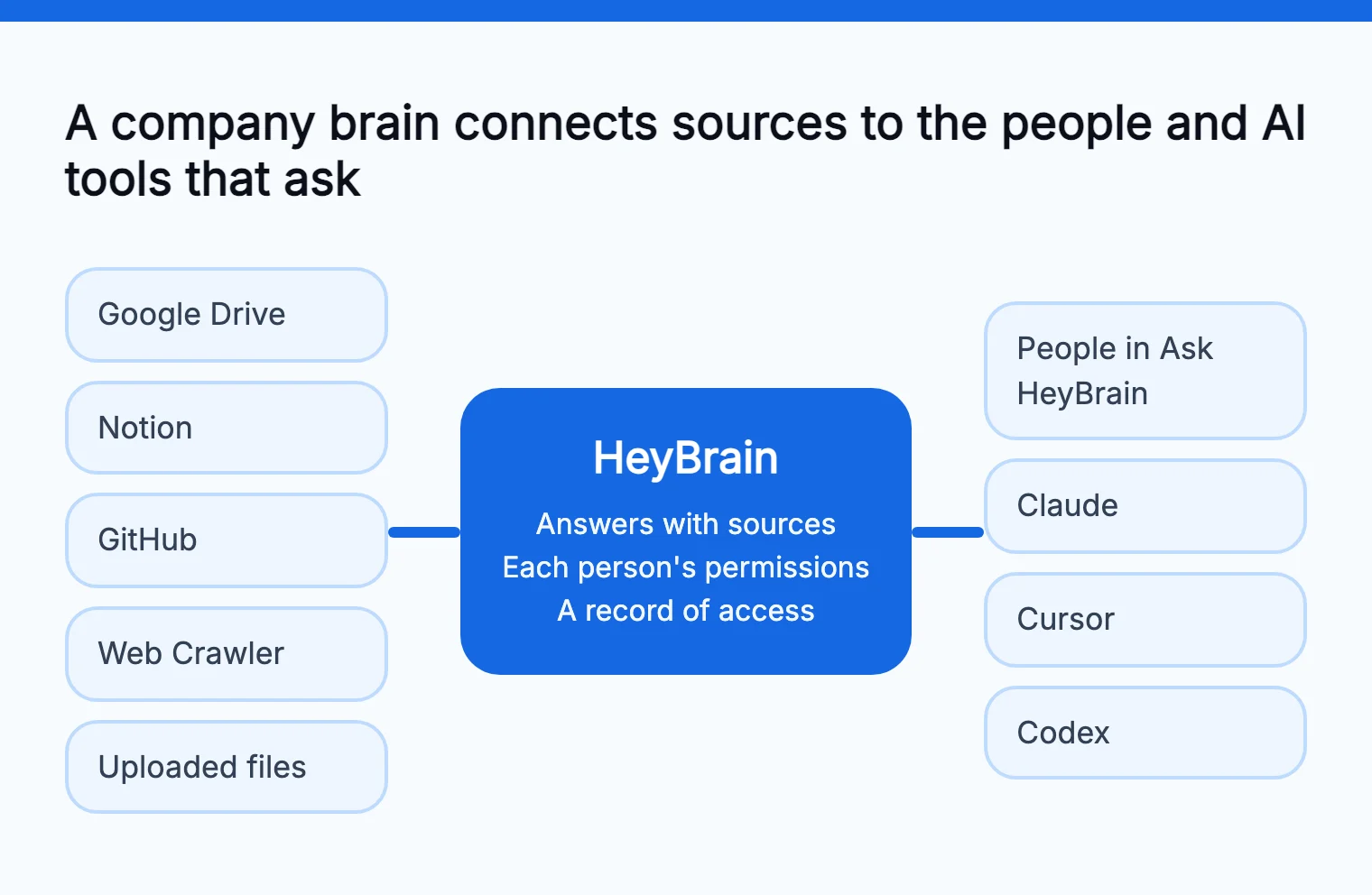
A company brain holds the working knowledge of a company: policies, plans, product docs, decisions, code and the notes around them. HeyBrain builds it from the places that knowledge already lives, such as Google Drive, Notion, GitHub, websites read by the Web Crawler and uploaded files, so nobody has to copy it into a new system first.
It is not a dump of every message ever sent. You choose the sources worth trusting, and HeyBrain ties each answer to the document it came from.
How is a company brain different from a wiki or a knowledge base?
A company brain differs from a wiki or a knowledge base in where the knowledge lives and who it serves. A wiki asks people to write everything down in one place. A company brain, as HeyBrain builds it, reads the sources you already keep and answers both people and AI agents from them, with each person's access respected.
| Tool | What it is | Who asks it | Where the knowledge lives |
|---|---|---|---|
| Wiki | Pages people write and maintain | People | In the wiki itself |
| Knowledge base | Curated articles, often for support | People, sometimes customers | In the knowledge base |
| Enterprise search | One search box across company apps | People | In each connected app |
| AI memory | Facts one AI tool remembers between chats | That one AI tool | Inside that tool |
| Second brain | One person's notes and ideas | One person | In a personal notes app |
| Company brain | Shared knowledge with sourced, permission-aware answers | People and AI agents | In your existing sources, connected once |
The lines between these tools are blurring, as search tools add assistants and knowledge bases add AI answers. A simple test still separates them: can people and AI agents both ask it, does every answer show its source, and does it respect who is asking? HeyBrain is designed to pass all three.
Why do companies want a company brain now?
Companies want a company brain now because every AI tool starts from zero. Each chat app, coding assistant and agent keeps its own memory, so people paste the same context again and again, and each tool ends up with a different picture of the company. HeyBrain gives all of them one shared source to read from instead.
The idea also has investor attention. Y Combinator listed a company brain request from Tom Blomfield, and HeyBrain's breakdown of YC's company brain thesis covers what that request says and what it leaves open.
What does a good company brain need?
A good company brain needs five things: connected sources, permissions that follow the person asking, a record of access, answers with sources, and a place inside the AI tools people already use. HeyBrain is built around all five. Without any one of them, it slips back into a search box or a chatbot nobody can check.
- Connected sources. It reads where work already lives, so knowledge stays current without a second copy to maintain.
- Permissions that follow the person. A sales rep and a finance lead can ask the same question and get answers scoped to what each may see.
- A record of access. You can see which person asked each question, and when.
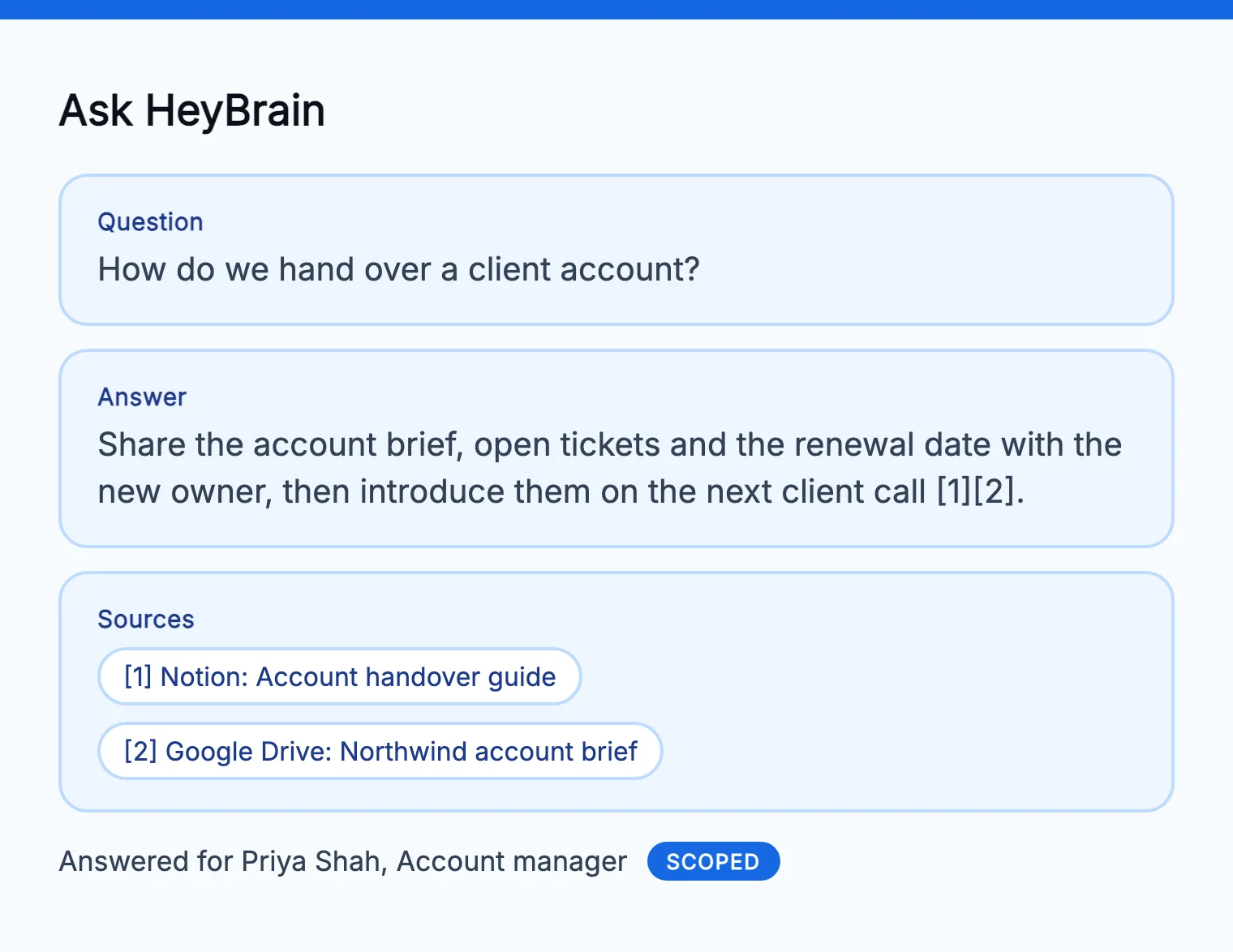
- Answers with sources. Every answer links to the documents behind it, so people can check before they act.
- Works inside your AI tools. People keep using Claude, Cursor or Codex, and those tools read the same knowledge through MCP, an open standard that lets AI tools call outside services.
How does HeyBrain work as a company brain?
HeyBrain works as a company brain by connecting your sources once and answering from them wherever people ask. Google Drive, Notion, GitHub, the Web Crawler and file uploads connect today, with Slack, Gmail, Google Calendar, Fireflies and PostHog in beta. People ask in Ask HeyBrain, and their AI tools ask over MCP.
Each answer cites its sources and is scoped to the person or agent asking, and HeyBrain keeps a record of which person asked each question. Connected content is not used to train AI models, and you can bring your own model key for Claude, OpenAI or Gemini. The AI knowledge base page shows how sources and answers fit together.
Where should you go next?
Where you go next depends on how far along you are. If you are comparing tools, start with HeyBrain's guide to the best company brain platforms. If you are ready to build, follow the steps to build a company AI brain, then use the company brain maturity model to decide what to improve next.
If you arrived from the wider idea of an AI brain, HeyBrain's explainer on what an AI brain is covers that term for individuals and agents.
Frequently asked questions
Is a company brain the same as a knowledge base?
No. A knowledge base holds articles someone wrote and keeps up to date. A company brain reads the sources your team already uses and answers questions from them with citations. HeyBrain can include a knowledge base as one source, alongside drives, docs and code, and answer across all of them for people and AI agents.
How is a company brain different from a second brain?
A second brain is one person's private notes. A company brain is shared across a team and its AI tools, so it needs permissions, a record of access and sources everyone trusts. HeyBrain covers the shared case: the same knowledge reaches every person and agent, scoped to what each is allowed to see.
Can AI agents use a company brain?
Yes. AI agents can ask a company brain the way people do, usually through MCP, an open standard that lets AI tools call outside services. With HeyBrain, tools such as Claude, Cursor and Codex read company knowledge with sources, and an agent never sees more than the person who connected it.
What should a company brain connect to?
Start with the sources people already trust for answers: shared drives, team docs, code repositories and your public website. In HeyBrain that means Google Drive, Notion, GitHub and the Web Crawler today, plus file uploads. Add conversation sources such as Slack, Gmail or Fireflies once the core documents answer well.
Who can see what in a company brain?
Each person sees only what they are allowed to see. A good company brain checks access on every question, so two people asking the same thing can get different answers. HeyBrain answers under the permissions you set and keeps a record of which person asked each question.
How long does it take to set up a company brain?
Setup time depends on how many sources you connect, not on writing new content. With HeyBrain you sign up, connect a first source such as Google Drive or Notion in the app, and start asking. Begin with one or two trusted sources and add more as the answers prove useful.
A company brain is shared, sourced and permission-aware knowledge that people and AI agents can both ask. HeyBrain builds one from the tools your team already uses.