

The 7 best company brain platforms for teams in 2026
The best company brain platform depends on where your work already lives: Microsoft 365 Copilot for Microsoft 365 companies, Atlassian Rovo for Jira and Confluence teams, Notion AI for Notion workspaces, Glean for large enterprises with many apps, and HeyBrain when people and several AI tools need the same knowledge with one record of access.
- We compared seven platforms on sources, permissions, records of access, AI tool support, agents, setup and pricing, using each maker's own pages on November 24, 2026.
- All seven say their answers respect the access people already have; they differ on records of access, plan requirements and which AI tools can ask.
- Microsoft 365 Copilot interactions are logged in Purview Audit (Standard) when auditing is on, the clearest built-in record among the large suites.
- Glean and Guru publish no prices, and Atlassian moves Rovo to usage-based credits on December 3, 2026.
- Supermemory open-sourced its company brain in September 2026 for teams that want to run their own.
Contents

Company brain platforms
Seven compared for 2026
What is a company brain platform?
A company brain platform is software that connects a company's documents and tools so people and AI agents can ask questions and get sourced answers that respect each person's access. HeyBrain covers the idea itself in its guide to what a company brain is; this page compares the platforms that build one.
How did we choose these platforms?
We chose platforms that present themselves as a shared knowledge layer for people and AI, then checked each against seven criteria on its maker's own pages. HeyBrain applied the same criteria to itself. Tools that only store one person's notes, or only remember chats for one AI app, did not make this list.
- Connected sources: which apps and files it reads.
- Permissions: whether answers respect what each person may already see.
- Record of access: whether you can review who asked for what.
- Works inside your AI tools: its own apps, plus MCP, an open standard that lets AI tools call outside services.
- Support for agents: whether you can build or connect AI agents.
- Setup: self-serve sign-up or a sales-led rollout.
- Pricing transparency: whether prices are published.
How do the best company brain platforms compare?
The best company brain platforms differ less on permissions, which all seven address, than on where they work, who can review a record of access and how openly they price. HeyBrain is our product. Every other tool is described from its maker's own pages, checked on November 24, 2026.
| Platform | Best for | Knowledge sources | Works inside | Permissions | Record of access | Agents | Setup | Pricing model |
|---|---|---|---|---|---|---|---|---|
| HeyBrain | People and several AI tools sharing one source | Google Drive, Notion, GitHub, Web Crawler and uploads; Slack, Gmail, Google Calendar, Fireflies and PostHog in beta | Ask HeyBrain; Claude, Cursor and Codex over MCP | Answers under the permissions you set | Record of which person asked each question | AI agents connect with their own scoped keys | Self-serve sign-up | Published plans, 14-day Pro trial |
| Glean | Large enterprises with many apps | 275+ connectors | Glean apps; MCP server with 22 documented hosts, including Claude, ChatGPT and Cursor | Source permissions inherited and enforced | Admin audit logs (30 days by default); end-user events in separate logs | Glean Agents | Sales-led demo; Glean-hosted or customer-hosted | Not published |
| Microsoft 365 Copilot | Microsoft 365 companies | Microsoft Graph plus 100+ prebuilt connectors | Word, Excel, PowerPoint, Outlook and Teams; Copilot Studio agents can call MCP servers | Shows only data the user can already view | Logged in Purview Audit (Standard) when auditing is on | Researcher and Analyst; build with Copilot Studio | Self-serve add-on to an eligible plan | $30 per user/month, paid yearly (enterprise add-on) |
| Notion AI | Teams whose docs live in Notion | Notion plus connectors such as Slack, Google Drive and GitHub | Notion; Notion MCP for Claude, Cursor and ChatGPT | Keeps Notion permissions | Audit log on Enterprise | Notion Agent and Custom Agents | Self-serve; Enterprise through sales | Business $20 per seat/month, with AI credits |
| Dust | Teams building their own agents | Slack, Notion, Google Drive, GitHub and more; any tool via MCP | Dust app; agents can call remote MCP servers | Admins choose synced data and restricted Spaces | Audit logs on Enterprise | Custom agents and multi-agent orchestration | Self-serve Business; Enterprise through sales | Pro 24€ per seat/month, paid yearly |
| Guru | Verified answers in many AI tools | 100+ integrations | Guru, Slack, Teams and browser; MCP server for ChatGPT Enterprise, Claude and Cursor | Role-based permissions enforced everywhere | Centralized audit logs | Knowledge Agents | Sales-led | Not published (custom packages) |
| Atlassian Rovo | Jira and Confluence teams | Atlassian apps plus Teamwork Graph connectors | Atlassian apps and browser extension; Atlassian MCP server for Claude, ChatGPT and Cursor | Respects permissions in connected apps | Admin actions with Guard Standard; user actions with Guard Premium | Rovo Agents and Rovo Studio | On by default in paid Cloud plans | Included credits; $0.01 per extra credit from December 3, 2026 |
What does each company brain platform do best?
Each company brain platform below earns its place for a different kind of team, so the profiles cover what it is, who it suits, where it shines and what to check before you commit. HeyBrain comes first because it is our product; the order of the rest follows the table.
HeyBrain
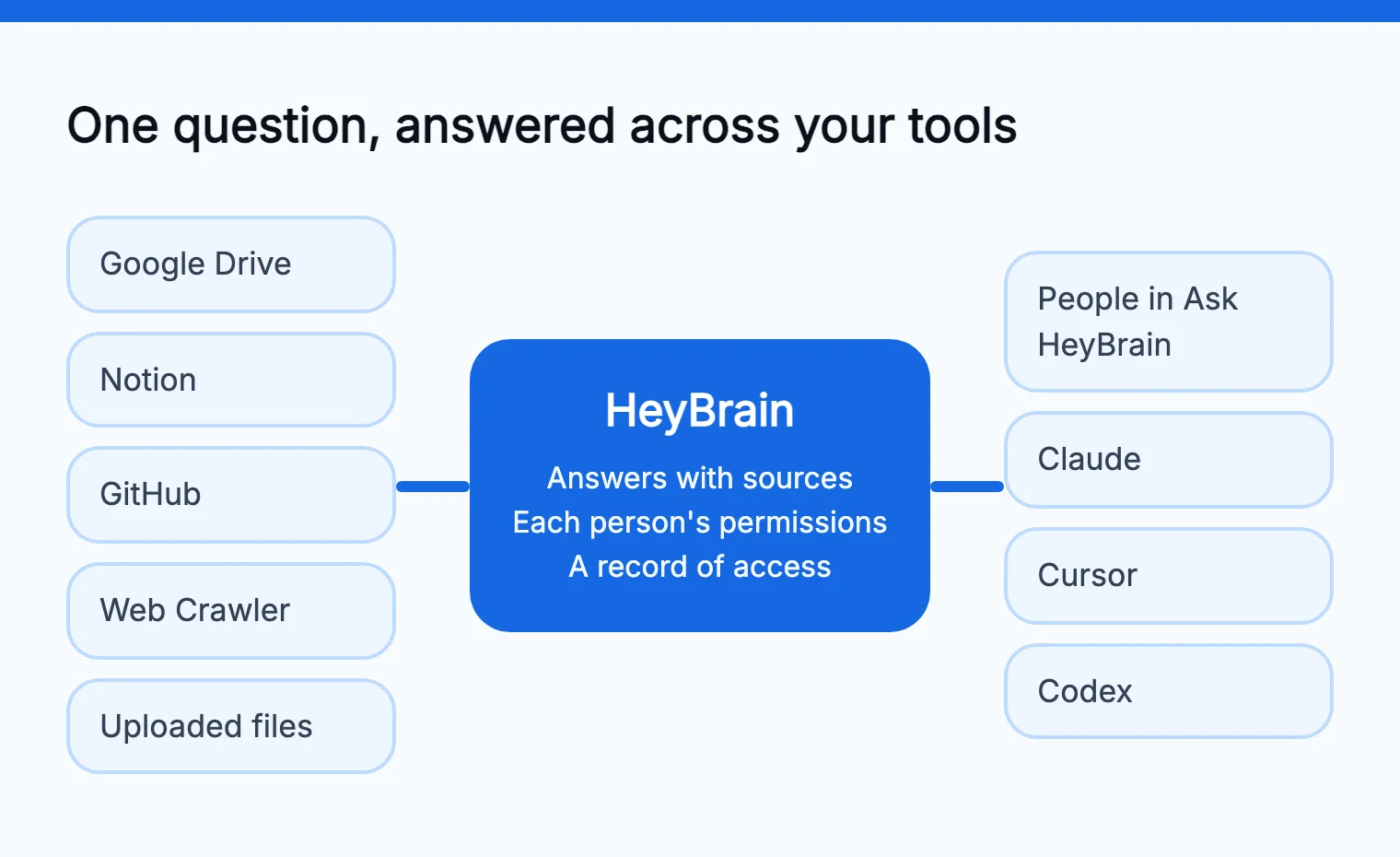
HeyBrain is a company brain for teams that use several AI tools and want one governed source behind all of them. It connects Google Drive, Notion, GitHub, the Web Crawler and file uploads today, with Slack, Gmail, Google Calendar, Fireflies and PostHog in beta. People ask in Ask HeyBrain, while Claude, Cursor and Codex ask over MCP.
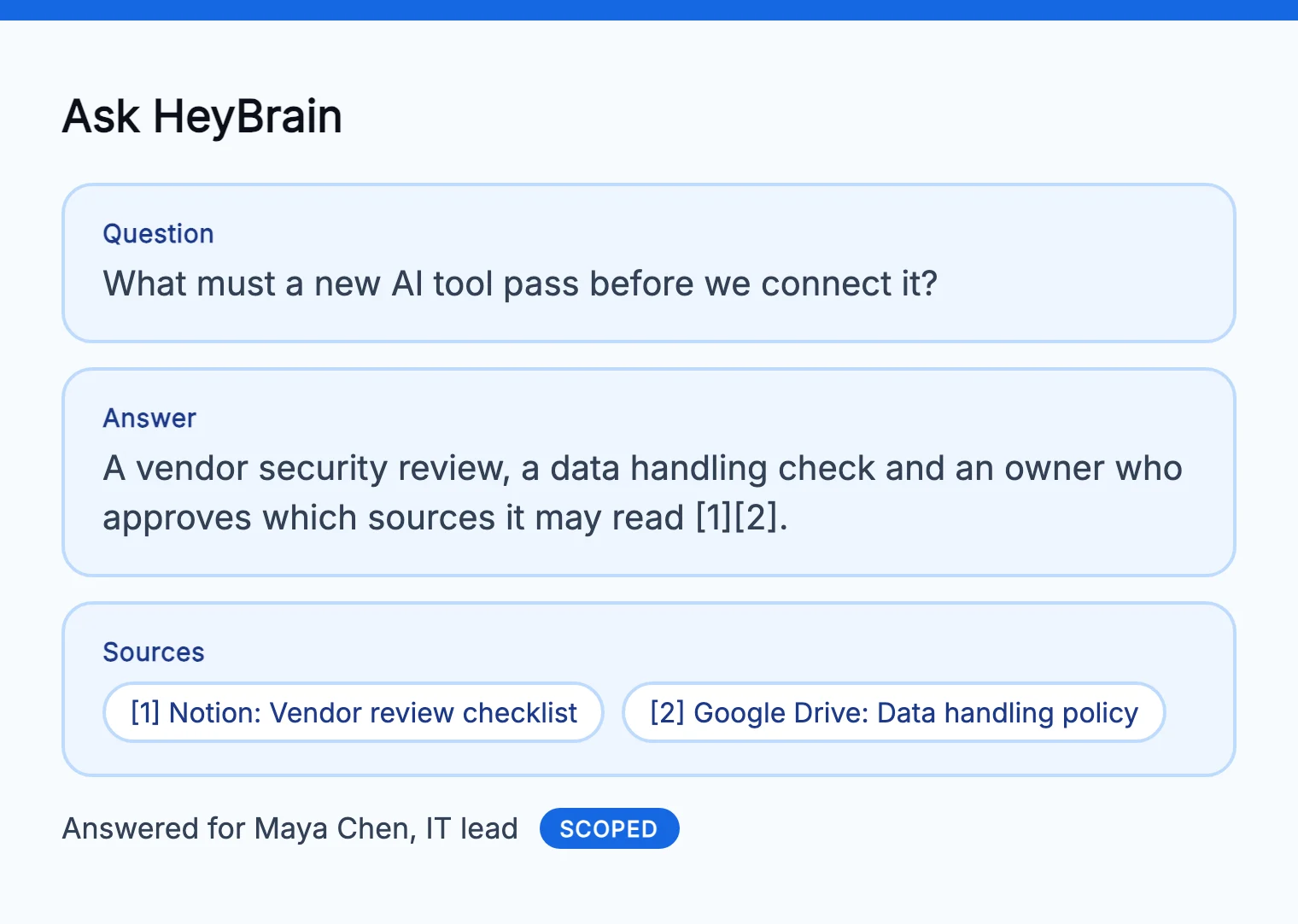
Each answer cites its sources, stays within the permissions you set and lands in a record of access, and connected content is not used to train AI models. Pick HeyBrain when the same knowledge has to reach people and agents across different tools. Check the connector list against the apps your team depends on, since it is shorter than the large suites' catalogues.
Glean
Glean is an enterprise AI platform that connects to company data through more than 275 connectors, with source permissions inherited and enforced. It suits large organisations that want search, an assistant and agents across many apps. Its MCP server documents 22 hosts, including Claude, ChatGPT, Cursor and Codex, so the same index reaches outside tools.
What to check: Glean's admin audit logs cover configuration rather than end-user activity, which it records in separate event logs, and retention defaults to 30 days. Pricing is not published, and buying starts with a demo. See how it lines up in HeyBrain vs Glean.
Microsoft 365 Copilot
Microsoft 365 Copilot brings AI into Word, Excel, PowerPoint, Outlook and Teams, grounded in Microsoft Graph and more than 100 prebuilt connectors. It suits companies whose work already runs on Microsoft 365. Its strongest governance point is the record: when auditing is on, Copilot interactions are logged under Purview Audit (Standard), including the files and emails it used.
What to check: Copilot surfaces whatever a user can already view, so Microsoft advises tightening SharePoint permissions first, and agents in Copilot Chat are metered. The enterprise add-on lists at $30 per user per month, paid yearly, on top of a qualifying Microsoft 365 plan. Compare it in HeyBrain vs Microsoft Copilot.
Notion AI
Notion AI answers inside the Notion workspace where many teams keep docs, wikis and projects, and reaches into Slack, Google Drive, GitHub and other apps through connectors on Business and Enterprise plans. Notion MCP lets Claude, Cursor and ChatGPT read the workspace while keeping Notion permissions. It suits teams that already write most things in Notion.
What to check: AI use runs on per-seat credits that pause when used up, connector ingestion can take up to 36 hours, and the audit log is Enterprise-only. Business lists at $20 per seat per month. More in HeyBrain vs Notion AI.
Dust
Dust is a platform for building and sharing AI agents across company knowledge and tools, with a choice of more than 20 frontier and open-source models. Admins choose what each connection syncs and group it into restricted Spaces, and agents can use remote MCP servers as tools. It suits teams that want to design their own agents rather than use a fixed assistant.
What to check: Dust's own pages give different connector counts, audit logs sit on Enterprise, and prices are in euros, from 24€ per seat per month on Pro, paid yearly. Compare it in HeyBrain vs Dust.
Guru
Guru presents itself as the governed knowledge layer for enterprise AI. It structures and verifies company knowledge, then delivers cited answers in Guru, Slack, Teams, the browser and, over MCP, in ChatGPT Enterprise, Claude and Cursor. Knowledge Agents can verify and unverify information, which suits teams where the accuracy of every answer matters more than the number of sources.
What to check: Guru publishes no prices and sells custom packages through its sales team, and its Microsoft 365 Copilot connector is listed as coming soon.
Atlassian Rovo
Atlassian Rovo is AI built into Jira, Confluence, Loom and Bitbucket, powered by Atlassian's Teamwork Graph and switched on by default in Standard, Premium and Enterprise Cloud plans. Connectors bring in tools such as Google Drive and SharePoint while respecting their permissions, and the Atlassian MCP server works with Claude, ChatGPT, Cursor and Codex.
It suits teams that plan and document their work in Atlassian. What to check: usage-based billing on Rovo credits starts December 3, 2026, and user-level Rovo audit logs need Atlassian Guard Premium.
Are there open-source company brain options?
Open-source company brain options exist for teams that want to run their own infrastructure. Supermemory released its company brain under the Apache 2.0 license on September 25, 2026, after closing the hosted version, and it deploys to Cloudflare. HeyBrain is the hosted route for teams that would rather not operate the stack themselves.
GBrain, built by Garry Tan to run his own AI agents, is the personal, do-it-yourself option: MIT-licensed Markdown in git with a database index, installed with Bun.
Which company brain platform should you choose?
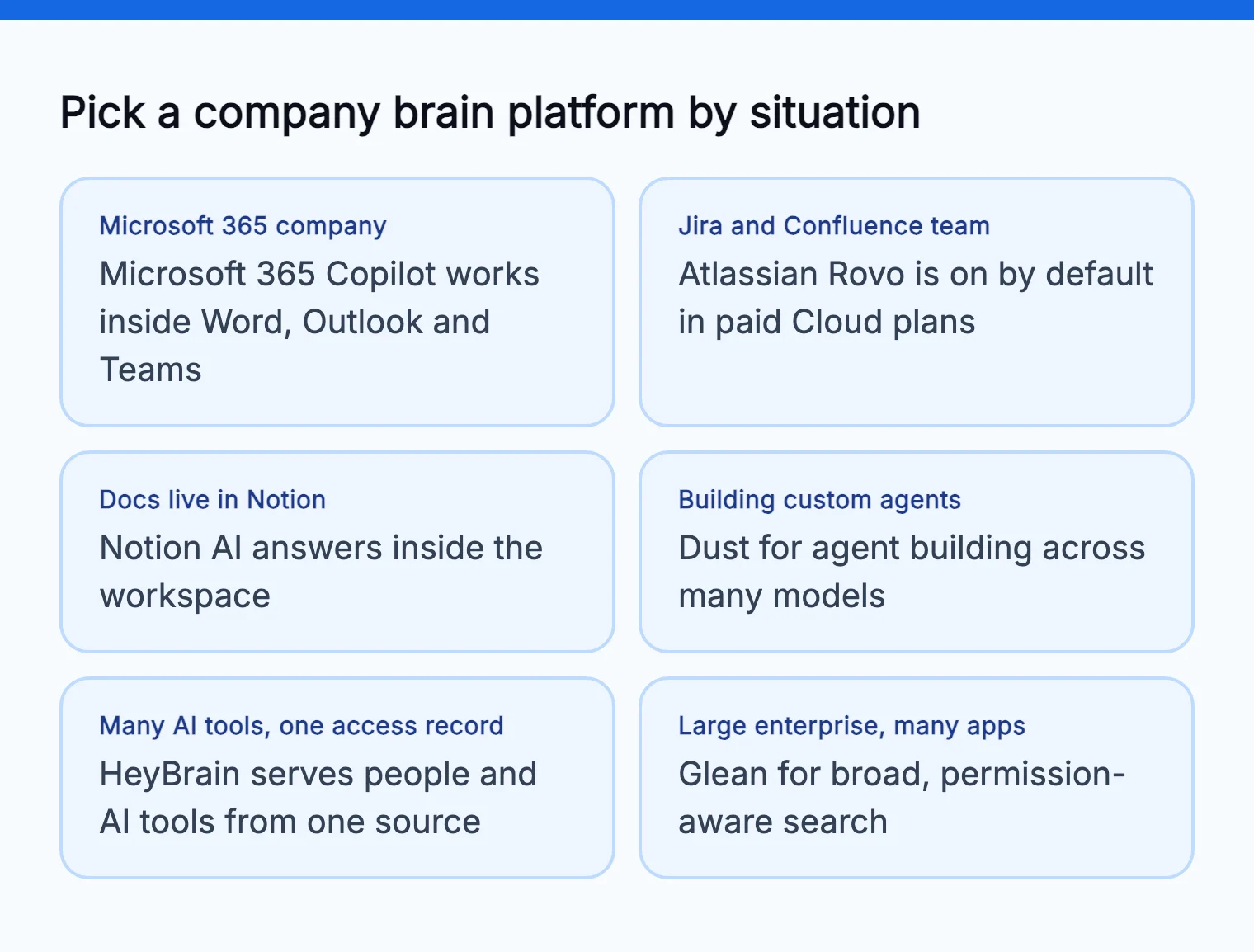
The right company brain platform follows your stack and your rules more than any feature list. HeyBrain's short guide below matches six common situations to the platform that fits best, including the situations where HeyBrain is not the first pick.
- A Microsoft 365 company: Microsoft 365 Copilot, because it works inside the apps your team already uses and logs interactions in Purview Audit when auditing is on.
- A Google Workspace and Notion team: Notion AI if most knowledge is written in Notion; HeyBrain if it is spread across Google Drive, Notion and GitHub and several AI tools need it.
- An engineering team building agents: Dust to design agents across many models, or HeyBrain to give coding tools such as Claude Code, Cursor and Codex one governed source of company knowledge.
- A regulated team that needs an access record: Microsoft 365 Copilot with Purview, Glean with its event logs, or HeyBrain with its record of which person asked each question.
- A small team that wants to be set up in an afternoon: HeyBrain or Notion AI, both self-serve, or Rovo if you already pay for Atlassian Cloud, since it is on by default.
- One person: a personal tool fits better than a team platform such as HeyBrain; start with the best AI brain tools.
How should you test a company brain platform before you buy?
Test a company brain platform with your own sources and your own access rules before you commit. HeyBrain suggests three checks: ask the same question as two people with different access, remove someone's access to a document and ask again, then look for the record of both requests. The AI brain tool security checklist covers the rest.
For a wider buying framework, including cost and rollout questions, read HeyBrain's guide on how to choose an AI brain tool.
How does HeyBrain work as a company brain platform?
HeyBrain works as a company brain platform by connecting your sources once and answering from them in Ask HeyBrain and in the AI tools your team already uses. Every answer shows its sources, respects the permissions you set and is recorded, so you can see which person asked each question. Plans and limits are on the pricing page.
Frequently asked questions
What is the best company brain platform?
The best company brain platform is the one that matches where your knowledge lives. Microsoft 365 Copilot fits Microsoft 365 companies, Atlassian Rovo fits Jira and Confluence teams, and Notion AI fits Notion workspaces. HeyBrain fits teams whose knowledge spans several apps and whose people and AI tools all need the same sourced answers.
Is Glean a company brain?
It covers much of the idea: Glean connects more than 275 apps, enforces source permissions and answers through its assistant, agents and an MCP server. HeyBrain uses company brain for the same job of shared, permission-aware knowledge, with a record of which person asked each question.
Can I build a company brain in Notion?
Yes, if your knowledge is mostly written in Notion. Notion AI answers across the workspace, connects some outside apps on Business and Enterprise plans, and Notion MCP keeps Notion permissions for Claude, Cursor and ChatGPT. HeyBrain can also connect Notion as one source alongside Google Drive and GitHub when knowledge lives in several places.
Is there an open-source company brain?
Yes. Supermemory released its company brain as open source under Apache 2.0 in September 2026, built to deploy on Cloudflare. GBrain, by Garry Tan, is an MIT-licensed, self-hosted option aimed at personal use with AI agents. HeyBrain is the hosted alternative for teams that want permissions and a record of access without running infrastructure.
What does a company brain cost?
Costs vary widely. As of November 24, 2026, Microsoft lists its Copilot enterprise add-on at $30 per user per month paid yearly, Notion Business costs $20 per seat per month, and Dust Pro costs 24€. Glean and Guru publish no prices. HeyBrain lists its plans, including a 14-day Pro trial, on its pricing page.
Do company brain platforms work with Claude and ChatGPT?
Most do, through MCP, an open standard that lets AI tools call outside services. Glean, Notion, Guru and Atlassian all document MCP servers that Claude can use, and each also lists ChatGPT or ChatGPT Enterprise. HeyBrain connects to Claude, Cursor and Codex over MCP, so those tools answer from the same company knowledge as the people on your team.
How do company brain platforms handle permissions?
They check access when a question is asked, so an answer only uses content the person may see. Microsoft, Glean, Notion and Rovo say they respect source permissions, while Dust uses admin-chosen data and Spaces. HeyBrain answers under the permissions you set and records which person asked each question, so access can be reviewed later.
Choose the company brain platform that sits where your team already works, then test it with your own sources and access rules. When people and several AI tools need the same sourced answers, HeyBrain is built for that job.