

Supermemory vs Mem0: Which should be your agents' central brain?
Pick Supermemory if you want one API for memory, user profiles, documents and connected sources, with built-in forgetting. Pick Mem0 if you want an open-source memory layer you can run yourself or use hosted. Both work with Claude and other AI tools over MCP (Model Context Protocol, an open standard that lets AI tools call outside services).
- Mem0 is open source under Apache 2.0, as a library, a self-hosted server or the hosted Mem0 Platform.
- Supermemory's repository, plugins and SDKs are open source, but its memory engine is not; supermemory local is a free self-hosted binary for up to 10,000 documents.
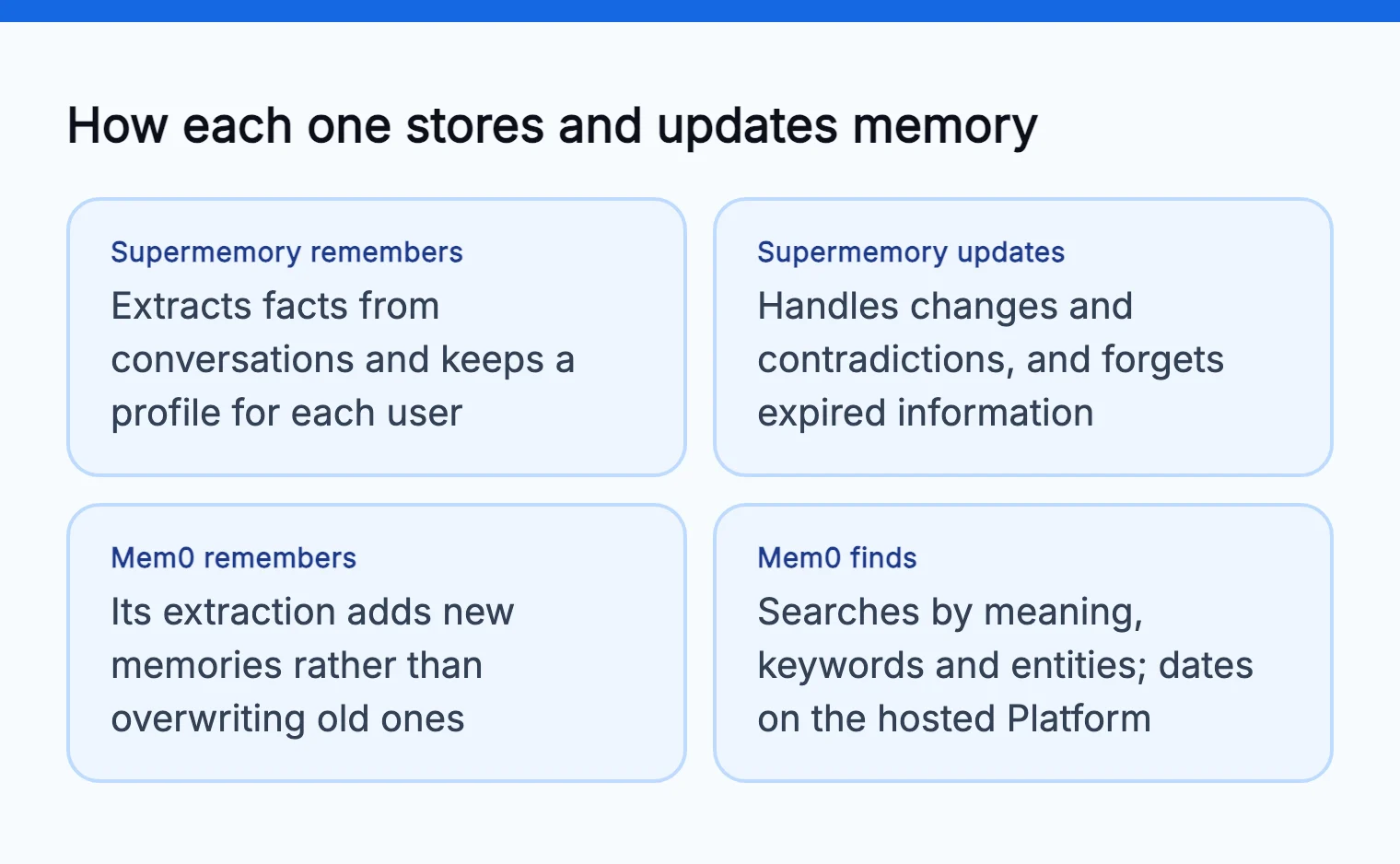
- Supermemory handles updates, contradictions and forgetting; Mem0's extraction adds new memories rather than overwriting old ones, and links entities across them.
- Both publish benchmarks that favour themselves, so test each on your own data.
- For company documents under each person's permissions, teams add a knowledge layer such as HeyBrain alongside either one.
Contents

Supermemory vs Mem0
A central brain for your agents
What is a central brain for AI agents?
A central brain for AI agents is one shared memory that every agent and app reads from and writes to, so context learned in one place is available everywhere else. We found no AI memory product called Central Brain: the closest match is a French consultancy service, not a memory API. Here the phrase means that shared memory, and Supermemory and Mem0 are two common ways to build it.
How do Supermemory and Mem0 compare?
Supermemory and Mem0 both give agents long-term memory through an API, an SDK and an MCP server (Model Context Protocol, an open standard that lets AI tools call outside services). They differ most on what is open source, how memory changes over time and how sharing works. Each is described from its own pages and repository, checked on November 24, 2026.
| Supermemory | Mem0 | |
|---|---|---|
| Made by | Supermemory, a research lab building memory and continual learning systems for agents | Mem0, a Y Combinator S24 company |
| What it is | A memory and context API: memory, RAG, user profiles, connectors and file processing in one system | A memory layer for AI agents and apps |
| Built for | Developers adding memory and context to agents and apps; also supermemory Brain, for personal use across your agents | Developers building assistants, support bots and autonomous agents |
| Open source | Partly: the main repository and plugins are MIT and the SDKs Apache 2.0; the memory engine itself is not open source | Yes, Apache 2.0, for the library and the self-hosted server |
| Hosting | Supermemory's cloud; supermemory local, a free self-hosted binary for up to 10,000 documents; a self-hosted option on the Scale plan | The Python or npm library, a self-hosted server with Docker Compose, or the hosted Mem0 Platform; on-premises on the Custom plan |
| How memory is stored and updated | Extracts facts from conversations, keeps user profiles, handles updates and contradictions, and forgets expired information | A single extraction pass that adds new memories rather than overwriting old ones, while the hosted Platform supersedes outdated facts; entities are linked across memories, and search combines meaning, keywords and entities (dates on the hosted Platform) |
| Works with (SDKs, MCP) | TypeScript and Python SDKs, wrappers for AI frameworks such as the Vercel AI SDK, and a hosted MCP server for Claude Desktop, Claude Code, Cursor, Windsurf, VS Code, OpenCode, OpenClaw and Hermes | Python and npm SDKs, a CLI, integrations such as LangGraph and CrewAI, and a hosted MCP server for Claude Desktop, Claude Code, Codex, Cursor, Windsurf, VS Code and OpenCode |
| Sharing across users, agents or teams | Memory scoped by projects (container tags); the Scale plan adds unlimited team seats with per-tag access | Memory kept per user, session and agent; organizations and projects with Reader and Owner roles |
| Pricing model | Free with $5 of credits; Pro $19 a month (3 seats); Max $100; Scale $399; Enterprise custom | A free plan with monthly limits on adds and retrievals; a Custom plan on request with SSO, audit logs and on-premises |
| Best for | One API for memory plus documents and connected sources, with built-in forgetting | An open-source memory layer you can run yourself or use hosted |
What does Supermemory offer today?
Supermemory offers a memory API for agents and apps, an MCP server and supermemory Brain, for personal use across your agents. In September 2026 it discontinued its hosted company brain and its Nova product to focus on the memory API, refunded everyone who had been charged, then open-sourced the company brain on September 25, 2026 under Apache 2.0. HeyBrain, our product, is a different kind of tool, covered further down.
The API combines several jobs in one call. It stores conversations as memories, keeps a profile for each user, and runs hybrid search that returns relevant documents and personal context together. Connectors sync Google Drive, Gmail, Notion, OneDrive and GitHub, and extractors read PDFs, images, video and code. The Supermemory repository has the quickstart and the MCP setup.
What does Mem0 offer today?
Mem0 offers an open-source memory layer for AI agents, licensed Apache 2.0, in three forms: a library you install with pip or npm, a self-hosted server and the hosted Mem0 Platform. It keeps memory for each user, session and agent, so an assistant can remember a person across conversations and an agent can remember what it did.
Its current extraction runs in a single pass and adds new memories rather than overwriting old ones, and facts an agent confirms are stored with the same weight as what a user says. Memories can still change: Mem0's MCP can update them, and the hosted platform supersedes outdated facts. Entities are linked across memories, and retrieval combines meaning, keywords and entities, with dates on the hosted platform. The README notes that the hosted platform includes optimizations the open-source library does not. The Mem0 repository covers all three options.
Is Supermemory or Mem0 better on benchmarks?
Both publish benchmark results, and both publish results that favour themselves. Supermemory reports leading scores on LongMemEval, LoCoMo and ConvoMem; Mem0 reports its own scores on LoCoMo, LongMemEval and BEAM. Each runs its own tests on its own setup, so the numbers are not a neutral comparison, and neither is a reason to pick one on its own.
The honest test is a small evaluation on your own data: a few dozen real conversations, the questions your agents must answer, and a check on what each tool recalls, misses and gets wrong after facts change. Our guide to comparing agent memory layers sets out how to run one.
Which memory layer works with Claude over MCP?
Both memory layers work with Claude over MCP. Supermemory's hosted MCP server lists Claude Desktop and Claude Code among its clients, along with Cursor, Windsurf, VS Code, OpenCode, OpenClaw and Hermes, and its MCP server is open source. Mem0's hosted MCP server lists Claude Desktop, Claude Code, Codex, Cursor, Windsurf, VS Code and OpenCode, with nothing to run on your own machine.
The setup differs. Supermemory's MCP signs in with OAuth, and its tools save, search and forget memories and pull a user's profile. Mem0's MCP signs in through the browser or an API key, and its tools can also update memories. Either way, the memory is the developer's to scope: which user, project or agent each saved fact belongs to.
Can a team share memory in Supermemory or Mem0?
A team can share memory in both, with different controls. Supermemory scopes memory by projects, called container tags, and its Scale plan adds unlimited team seats with access set per tag. Mem0 keeps memory per user, session and agent, and groups work into organizations and projects, where members are Readers or Owners.
In both, the developer decides what each user and agent may read, and the app built on top applies those rules. For a side-by-side with HeyBrain, see HeyBrain vs Supermemory and how HeyBrain compares with Mem0.
What does a team need beyond a memory API?
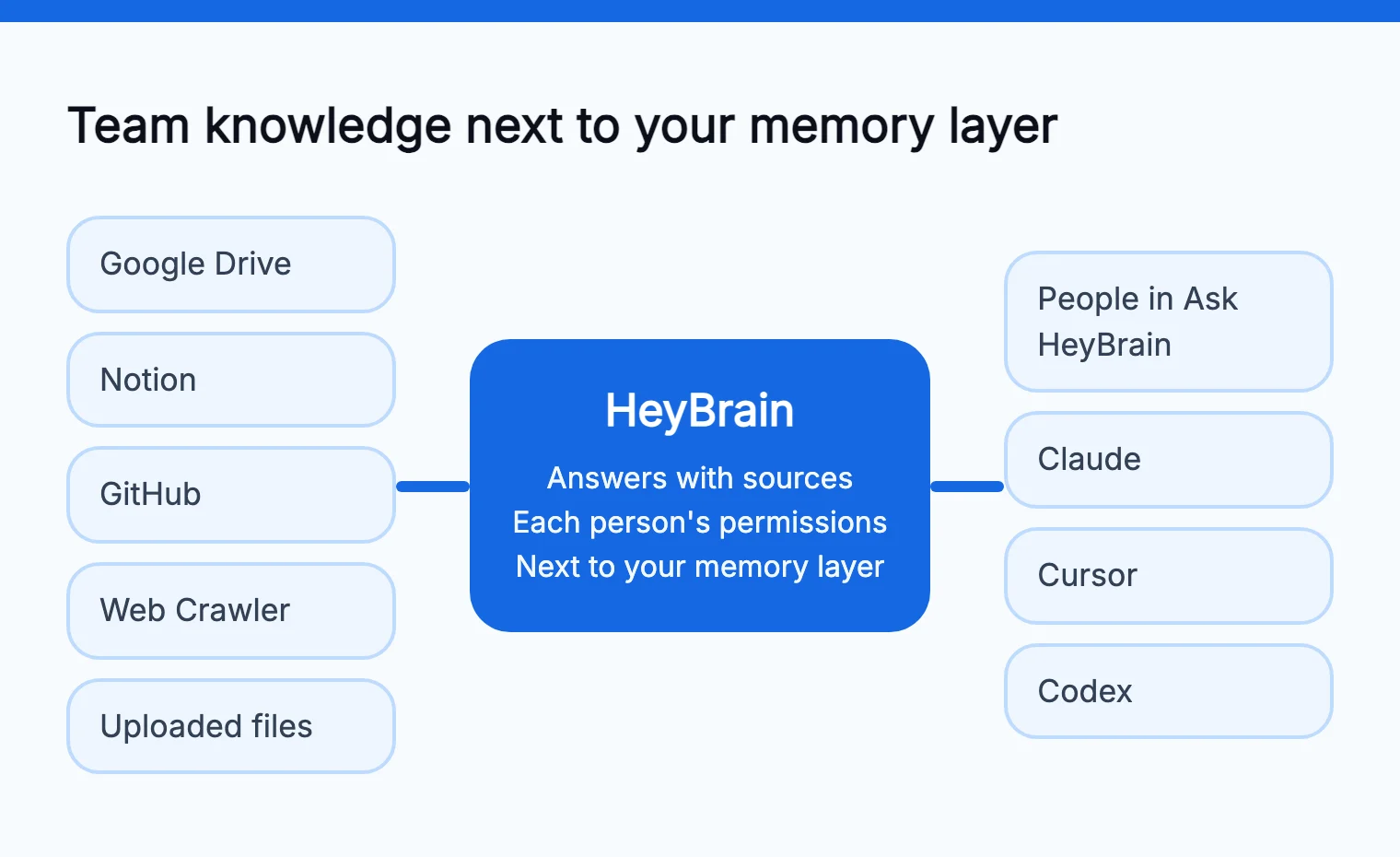
A team needs four things beyond a memory API: knowledge from the company's own documents, permissions inherited from each source, a record of who accessed what, and the same knowledge in the AI tools people already use. A memory API stores what users and agents said. HeyBrain is built for what the company knows, as a shared knowledge layer.
HeyBrain connects Google Drive, Notion, GitHub, the Web Crawler and file uploads, and answers with sources, within the permissions you set for each person and AI tool. People ask in Ask HeyBrain, while Claude, Cursor and Codex ask over MCP, and HeyBrain keeps a record of which person asked each question. It does not use connected content to train AI models.
Many teams use both: Supermemory or Mem0 for what each user and agent said, and HeyBrain for the documents and decisions the whole team relies on. The difference is set out in agent knowledge vs agent memory, and HeyBrain for AI agents covers the setup.
Which should be your agents' central brain?
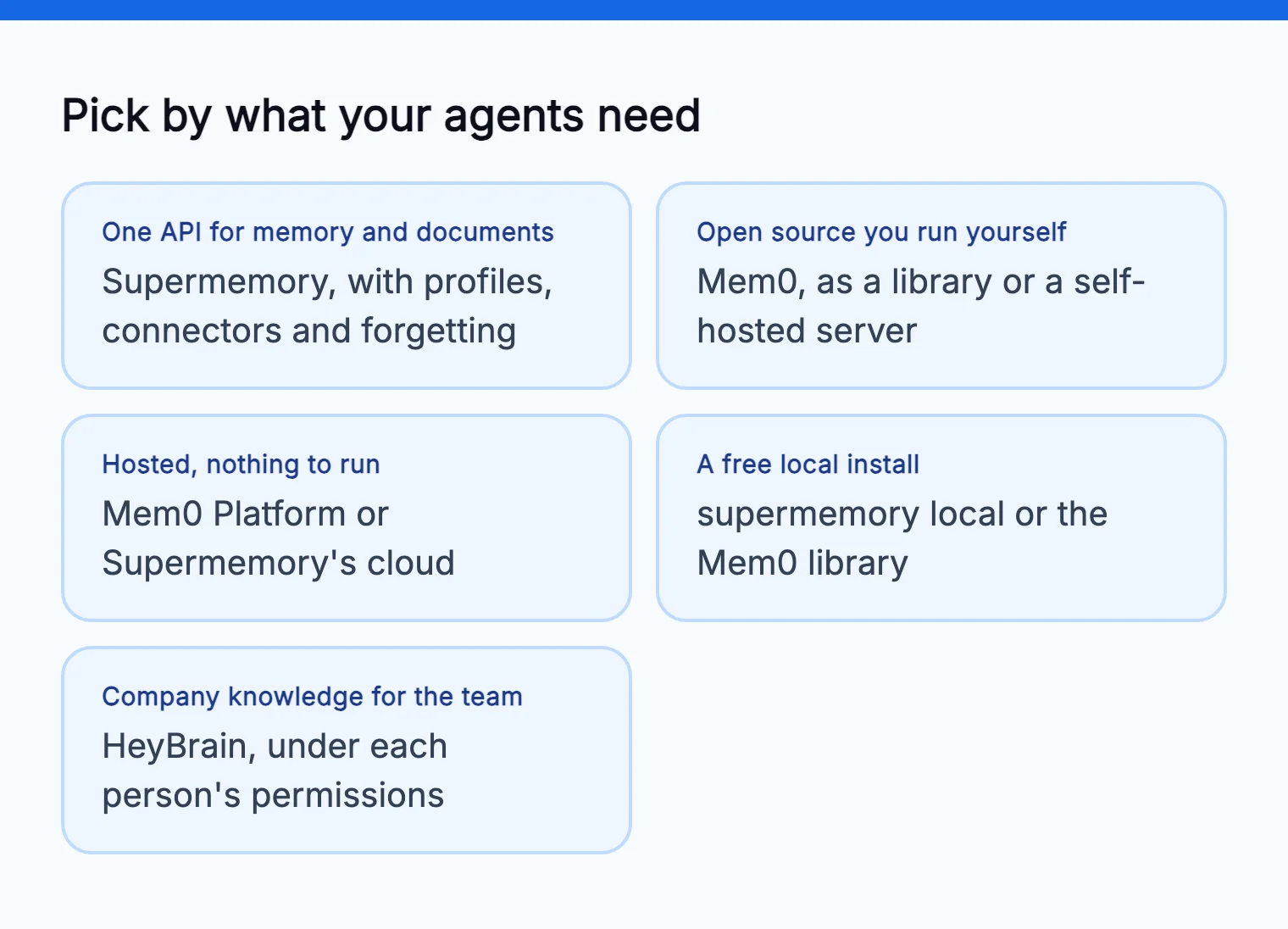
Your agents' central brain depends on what they need to remember and who will run it. Supermemory fits when one API should cover memory and documents, Mem0 when you want open source you control, and a knowledge layer such as HeyBrain when the whole team needs the company's documents. These situations each have a clear fit:
- One API for memory, user profiles, documents and connected sources, with built-in forgetting: Supermemory.
- An open-source memory layer you can run yourself, as a library or a server: Mem0.
- Memory per user, session and agent in a hosted service with nothing to run: either; Mem0 Platform or Supermemory's cloud.
- A free local install for a personal project: supermemory local, for up to 10,000 documents, or the Mem0 library.
- Shared company knowledge for people and AI tools, under each person's permissions: HeyBrain, alongside either memory layer.
Frequently asked questions
Is Supermemory better than Mem0?
Neither is better for every case. Supermemory suits teams that want memory, user profiles, documents and connectors in one API, with automatic forgetting. Mem0 suits teams that want an open-source memory layer they can run themselves. Both publish benchmarks that favour themselves, so test each on a small sample of your own data before you choose.
Is Supermemory open source?
Partly. Supermemory's main repository and plugins are MIT-licensed, its SDKs are Apache 2.0, and its MCP server is open source, but the memory engine itself is not. A free self-hosted binary, supermemory local, runs up to 10,000 documents and is not open source either. The team product it discontinued was released as open source under Apache 2.0.
Is Mem0 open source?
Yes. Mem0 is licensed Apache 2.0 and runs as a Python or npm library or as a self-hosted server. Mem0 also offers a hosted platform, and its README says that platform includes optimizations the open-source library does not, so results from the two versions can differ.
What is a central brain for AI agents?
A central brain for AI agents is one shared memory that all your agents and apps use, so something learned in one conversation is available in the next and in other tools. It is a plain phrase rather than a product name. Memory APIs such as Supermemory and Mem0 are common ways to build one.
Can a team share memory in Mem0 or Supermemory?
Yes. Mem0 organizes memory into organizations and projects, with Reader and Owner roles, and keeps it per user, session and agent. Supermemory scopes memory by projects, and its Scale plan adds unlimited seats with access set per tag. In both, the app you build decides which user or agent may read each memory.
What is the difference between agent memory and company knowledge?
Agent memory is what users and agents said: preferences, past conversations and actions taken. Company knowledge is what the organization has written down: documents, decisions and policies, each with its own access rules. Memory layers handle the first. HeyBrain handles the second, answering people and AI tools with sources under each person's permissions.
The short version
Pick Supermemory for one API covering memory and context, Mem0 for an open-source memory layer you can run yourself, and add HeyBrain when your team and its AI tools need the company's own knowledge under each person's permissions.