

How to Give Claude Duet a Shared Knowledge Layer
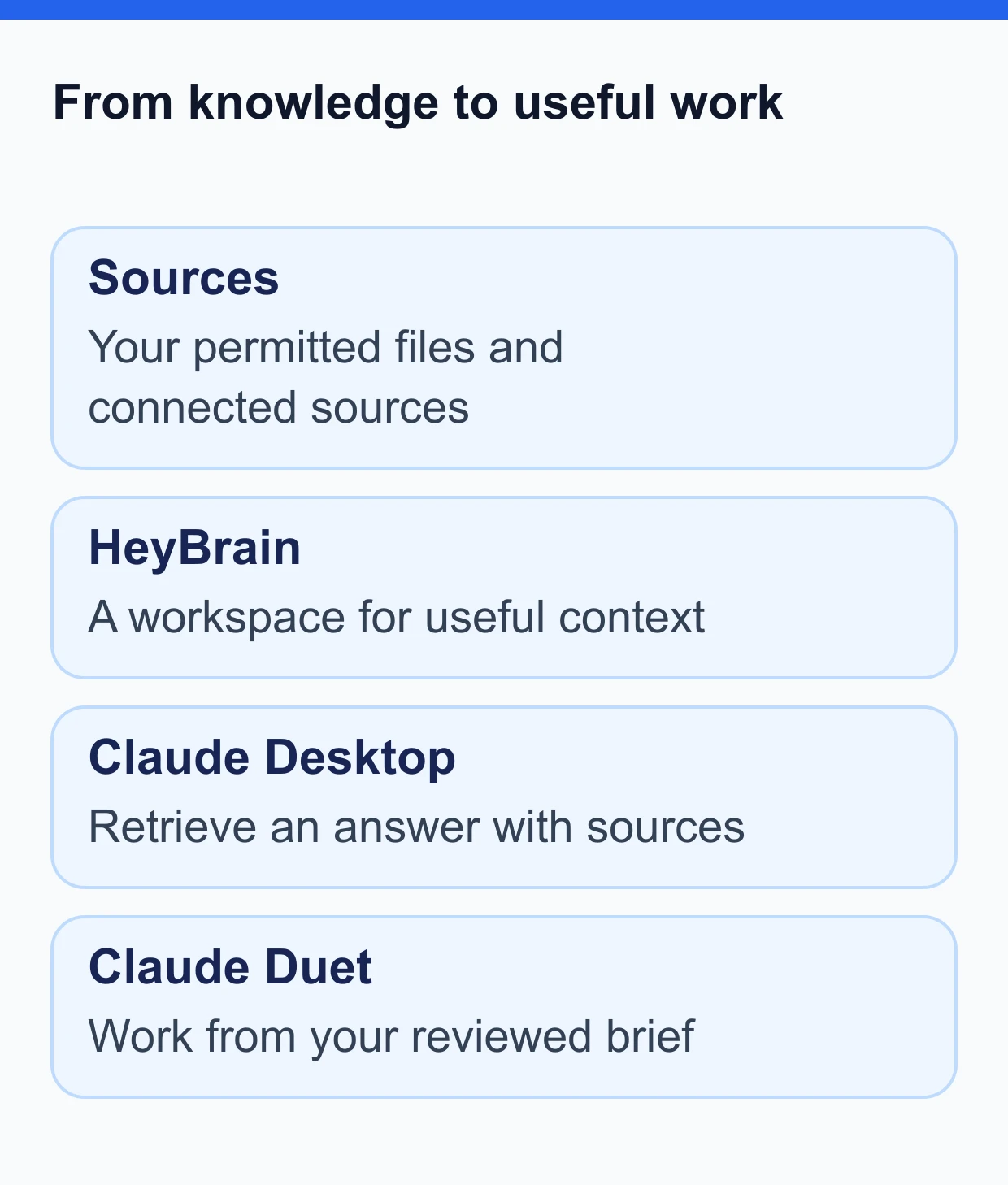
Give your Claude Duet workflow a shared knowledge layer by using HeyBrain alongside Claude and Duet. Connect HeyBrain to supported Claude Desktop, retrieve a source-backed brief, then give Duet the relevant context and task. HeyBrain keeps the knowledge organized; Claude helps you inspect it; Duet carries the work forward through its own tools.
- Duet already has Claude-account memory, skills, connected apps and eligible chat search.
- HeyBrain adds a maintained knowledge collection for people and supported clients.
- A reviewed, source-backed brief connects the knowledge step to the action step.
Contents

Claude Duet
Sources, access and connections
What does Duet already know?
Duet begins with Claude-account memory, skills and connected apps, and can search eligible past conversations. That gives it continuity without requiring you to restate everything in each message. A shared knowledge layer adds a maintained source collection alongside that context, useful when the facts you need live beyond the current conversation.
Anthropic documents chat search across Duet and Claude chats outside projects. It also lists limits around project content and local computer files. The starting question is therefore concrete: where is the information this task needs? Sometimes it is already in a connected app. Sometimes it is in a project document, approved note or collection that you want to make reusable through Claude.
What is a shared knowledge layer?
A shared knowledge layer is a maintained collection of information that authorized people and supported AI clients can retrieve for their work. It separates the source from the particular chat using it. HeyBrain calls this the shared context layer for your AI workforce: knowledge that remains useful as the conversation, person or supported tool changes.
The collection needs more than storage. A useful source has a title, an intended audience and enough context to establish what it supports. A project decision should identify the decision, its status and the relevant date. An approved customer answer should stay distinguishable from a draft suggestion. These distinctions make retrieved information useful at the point of action.
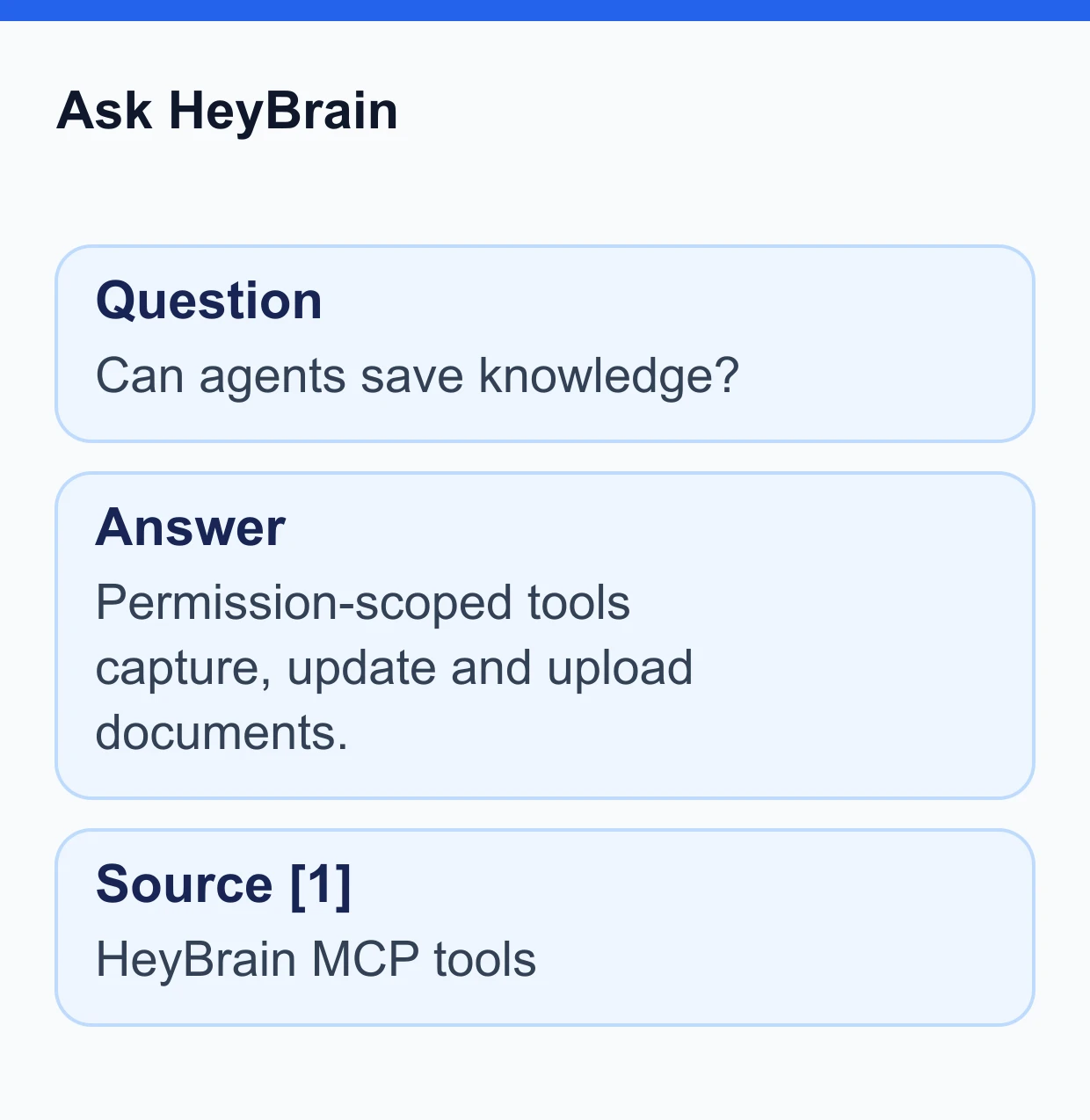
For the alongside workflow, connect HeyBrain to Claude through its documented Claude Desktop path. Ask Claude to retrieve the permitted source context, review the answer and citations, and hand Duet the relevant brief for its task. The same knowledge can serve repeated work without becoming an unstructured paste of every old conversation.
How do sources improve the answer you work from?
Sources improve an answer by giving you a way to inspect the support behind a claim. For a deadline, commitment or permission, the useful result is more than a confident sentence. You need the document and the passage that establish it, including the conditions that stop a narrow statement from becoming an overly broad promise.
Suppose a delivery note confirms the scope but leaves a date unresolved. A source-backed brief can preserve that distinction: confirmed scope, open timing and the person who must decide. That gives Duet a better task than “write a reassuring update”. It can prepare a draft around the actual agreement and leave the unresolved point for review.
Open the reference when a fact will drive an action. A citation that names the correct file is still not a substitute for reading the passage. The brief should separate source-supported facts from an interpretation or proposed next step. This makes the final task easier to approve and the next conversation easier to continue.
What changes across different AI tools?
A maintained knowledge workspace lets the source collection outlast any one chat. People can use the supported client connection that fits their work while keeping the relevant source organized in HeyBrain. The benefit is continuity of the knowledge collection, not a claim that every AI product has an identical connection or shares one universal memory.
A person preparing a report today and a colleague answering a follow-up tomorrow can begin from the same approved record when their access permits it. They do not have to reproduce the whole history from a screenshot or an old chat. The source remains identifiable even when the next task uses a different supported client or a different conversation.
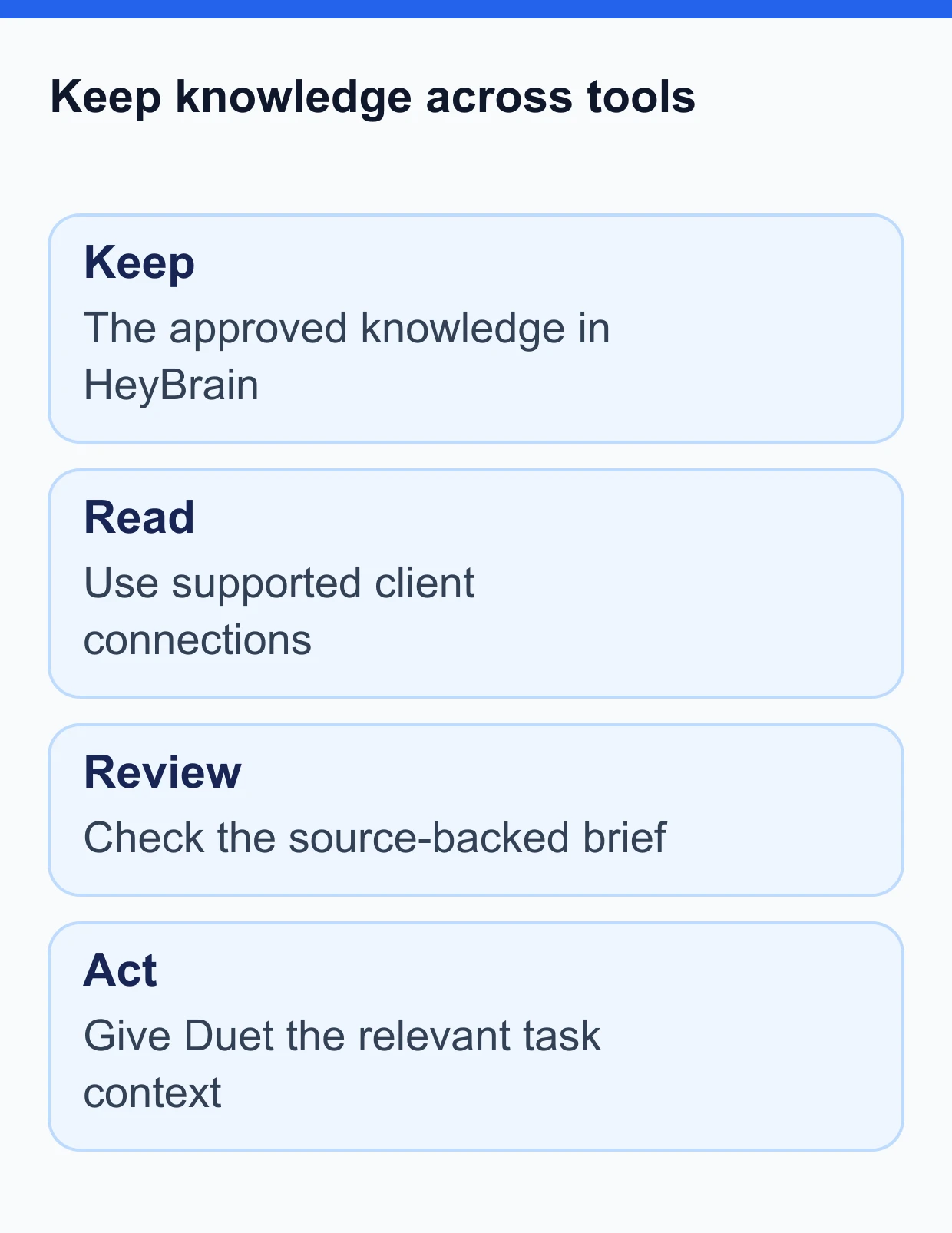
This also keeps the role of the agent clear. Claude can retrieve and organize the knowledge into a brief. Duet can then use that brief to prepare a deliverable or advance work in its connected apps. Context moves through a deliberate handoff instead of a vague expectation that every tool automatically knows what every other tool has seen.
How does this help briefs and deliverables?
A source-backed brief improves the starting material for call preparation, project updates and deliverables. It can identify the agreed position, the evidence, the open issue and the desired next step before the agent begins a larger task. That keeps the work focused on what is known rather than leaving an agent to fill gaps with plausible assumptions.
For a client meeting, gather the latest approved scope, relevant notes and questions that still need an answer. Ask Claude to produce a short brief with sources and a separate list of uncertainties. Give Duet the brief and ask for a meeting outline or follow-up draft. The outline now starts with your actual context instead of a generic template.
For a weekly project update, retrieve what changed since the previous decision and what remains unresolved. Review the difference, then ask Duet to turn the brief into the format the audience needs. Keep the intended recipients and approval point explicit. Useful source access should narrow a task, not silently expand its audience or action authority.
How does shared knowledge help a team?
Shared knowledge helps a team when colleagues can find the approved information their work requires without relying on one person’s recollection. The audience and source boundary still matter. A shared workspace should make the right knowledge available to the right person, rather than erase distinctions between internal, customer and project-specific material.
A new teammate preparing their first customer answer can work from the same approved product record as an experienced colleague. A project lead can update the decision once rather than explain it separately in every chat. The next source-backed brief can point to the updated record and keep the unresolved question visible.
Keep copied uploads and connected sources distinct. Uploaded copies have their own audience and refresh process; original source permissions do not automatically synchronize. For connected sources, use the connector’s actual behavior. These details are part of making shared context useful, because a convenient answer should not create unintended access.
Can this reduce repeated pasting?
A knowledge layer reduces the need to reconstruct the same source context manually for every question. Instead of pasting an entire archive, ask for the relevant material through a supported client and carry a concise, reviewed brief into the task. That changes the workflow from repeated collection to targeted retrieval and review.
The practical gain is that a source can be maintained where it belongs and reused when it matters. You still decide what the task needs and inspect the result. A broad retrieval can be as unhelpful as a broad paste, so ask a specific question and keep the brief tied to the decision or deliverable you want.
Duet and ordinary Claude work share a plan allowance. Keeping requests focused is therefore useful workload discipline. A separate knowledge service does not make the allowance unlimited, and the value should be judged by finished work and reduced repetition rather than a promised percentage saving. The Duet pricing guide explains that plan decision.
What knowledge should outlive the chat?
Keep the sources, decisions and useful records that another task will need, rather than save every exchange indiscriminately. A durable record should say what was decided, what supports it and which question remains open. That makes it useful after a new thread starts or a different colleague takes over the work.
Review the collection as the underlying work changes. Replace stale guidance deliberately, keep provenance where it helps and avoid mixing personal material into a team collection. The next retrieval should make the current record easier to use, not require a person to guess which of several old versions is authoritative.
Start with one recurring task and a small set of permitted sources. Add your knowledge to HeyBrain, connect it to Claude through the Claude guide, and produce a brief you can carry into Duet. The official Duet documentation explains the account context and task behavior that sit alongside this knowledge workflow.
Your next step
Choose one recurring task and the sources that can make it better. Keep the knowledge in a HeyBrain workspace, use Claude to turn it into a source-backed brief, and give Duet a clear task to carry forward.
Frequently asked questions
Does Claude Duet have memory?
Yes. Anthropic describes Claude-account memory, skills and connected apps carrying into Duet, along with eligible past-chat search. That context can support continuing work. A separate knowledge layer serves a different purpose: maintaining the documents and records you want people and supported clients to retrieve.
Can Claude Duet use my own documents?
Duet can work with the information available through its connected context and the task material you provide. In the HeyBrain alongside workflow, retrieve the permitted document context in supported Claude Desktop, review its citations and give Duet the relevant brief. Keep the source and action responsibilities clear.
Can a team share knowledge for a Duet workflow?
A team can maintain an approved knowledge collection in HeyBrain and retrieve it through supported clients according to access. A person can then carry a reviewed brief into their Duet task. Duet’s preview account eligibility remains separate from the shared workspace’s audience and permissions.
Does Duet see all my Claude projects?
Anthropic describes search across Duet and Claude chats outside projects, and lists limitations on project content and local files. Organize the context needed for the task rather than assume every project is already available. A source-backed brief makes the relevant material and its support explicit.
What is a shared knowledge layer?
It is a maintained source collection that authorized people and supported AI clients can retrieve for their work. Its value comes from useful context, provenance and an intended audience. It is not merely an archive of all conversations or a promise that every client automatically shares the same memory.
Does HeyBrain take the actions for Duet?
No. HeyBrain supplies knowledge and permission-scoped document tools. Duet uses its own connected tools to advance a task and seek required approvals. A useful brief informs the action; it does not itself grant authority to send a message, spend money or change an account.