


Claude Duet vs Muse, Grok Bot and Dots: Which AI Agent Fits You?
Claude Duet suits a Claude-centered workflow; Muse adds personal and small-business connections; Grok Bot emphasizes coordinated Bots and computer work; dots spans ChatGPT, Slack and Teams. Choose by the job, available access and control you need. HeyBrain adds a shared knowledge layer alongside those agent workflows, rather than competing as another agent.
- Duet’s preview is for invited US Pro and Max users, with shared Claude usage limits.
- Muse, Grok Bot and dots have distinct business or team capabilities; memory is not personal-only across this market.
- Use source-backed context and a bounded task to compare finished work, not feature counts.
Contents


Claude Duet
Compare proactive agents
What is Claude Duet?
Claude Duet is Anthropic’s proactive agent app, opened as a research preview on October 21, 2026. It uses Claude-account context and connected apps to prepare work, send a morning brief and advance tasks between your requests. The preview begins with invited US Pro and Max subscribers. Team and Enterprise accounts are not included in that preview.
A proactive AI agent is an assistant that can check information and advance a task between messages, within the access and action controls you give it. That is a different relationship from opening a chat, asking one question and receiving one answer. You still decide what work matters, which accounts it may use and which consequential actions to approve.
Duet’s natural starting point is an existing Claude workflow. Your memory, skills and connected apps carry over. You can type or speak in an ongoing thread, ask for a brief or hand over a larger deliverable. Its cloud computer keeps working when your own device is closed. The model is Claude Opus 5.5, with no model picker.
How do the four agents compare?
Compare Claude Duet, Muse, Grok Bot and dots by the job you need to finish, the accounts it must reach and the decisions you want to retain. Each has persistent context and background work. The differences become more useful when you separate access, computer control, organization support and pricing instead of declaring one universal winner.
| Decision | Claude Duet | Meta Muse | Grok Bot | OpenAI dots |
|---|---|---|---|---|
| Launch | Research preview, October 21 | September 8 | Beta, August 11 | September 29 |
| Access | Invited US Pro/Max subscribers | Rollout in US, Canada and Japan | Premium, Super, Ultra, Teams and Enterprise routes | Gradual Pro, Business Premium and Enterprise rollout |
| Price | Included with eligible Pro and Max | Free; Power $20 and Maximum $100 monthly in US documentation | Premium $30, Super $100, Ultra $200 monthly | Included with eligible plans |
| Model | Claude Opus 5.5 | Muse Spark | Automatic first- or third-party model routing | GPT-6 Astra |
| Computer | Own cloud computer and browser | Cloud computer/browser; current product also describes local-computer use | Cloud computer, browser, files and terminal | Cloud computer/browser; optional personal-computer connection |
| Background work | Briefs, connected-app checks and assigned tasks | Ongoing tasks across connected apps | Scheduled routines and ongoing Bot tasks | Ongoing tasks and proactive read-only research |
| Context | Claude memory, skills, connected apps and eligible chat search | Retained conversation details and connected apps | Persistent files/preferences, group context and Bot handoffs | Context across channels and learned preferences |
| Organizations | Preview not on Team or Enterprise | Small-business skills and connectors | Teams/Enterprise controls | Business Premium/Enterprise; organizational dots preview |
| Approvals | Specified consequential actions require approval | Sensitive actions and business sending/spending controls | Action/tool risk and Auto-review rules | Requirements, Custom Rules and auto-review; some work remains human-only |
The product introductions are Anthropic’s Duet announcement, Meta’s Muse announcement, Grok Bot’s current product page and OpenAI’s dots announcement. Later documentation supplies the current plan, rollout and organization details below.
When is Claude Duet the strongest starting point?
Claude Duet is a strong starting point when your useful context already lives in Claude and connected business apps, and you want that context carried into a proactive workflow. A morning brief, follow-up draft or larger work product can begin without moving to a different model ecosystem. Access through the preview remains the first practical requirement.
Consider an independent consultant who already uses Claude to prepare research and has the necessary email and calendar accounts connected. Duet’s brief and ongoing thread can support that pattern. The useful question is whether the result identifies the commitments, deadlines and decisions that consultant actually needs, rather than whether the brief sounds polished.
Anthropic says Duet checks connected accounts every few hours. It is therefore better understood as periodic proactive help than a real-time emergency channel. It can also make mistakes about urgency or a thread’s meaning. Its strengths around work tasks do not imply the same quality for every personal errand.
When should you look at Muse, Grok Bot or dots?
Look at Muse for a connected personal or small-business workflow, Grok Bot for coordinated Bots and computer-based tasks, and dots for work that moves across ChatGPT, Slack and Teams. These are useful evaluation starting points, not exclusive feature claims. The right choice depends on the app operation and control boundary your task requires.
Muse combines its personal-agent workflow with business skills and connectors. Meta’s small-business material includes services such as Notion, Shopify, Slack, Stripe and Zoom, alongside business accounts on Meta’s own platforms. For a small shop, the ability to reach the actual catalog, customer conversation or order source may matter more than a broad feature checklist.
Grok Bot documents Bots that coordinate through groups and handoffs, with persistent files and preferences. Its computer gives it a browser, filesystem and terminal. The different Bots on one user account are not separate security boundaries. A role name such as “research Bot” does not turn an otherwise shared computer or signed-in account into an isolated identity.
OpenAI’s dots carries context across channels and can work through a cloud computer. Its organization rollout includes Business Premium and Enterprise, while organizational dots are a preview. That makes it relevant to a team evaluating work across established communication surfaces. An eligible plan and a completed rollout are separate conditions.
What are the best Claude Duet alternatives?
The best Claude Duet alternative meets the requirement that is keeping you from doing useful work today. That could be preview access, a particular connected app, organization administration or a computer you can inspect. Start with the missing requirement, then compare the current offer. A free tier and a paid organization deployment are not equivalent units.
If a US-only waitlist is the obstacle, compare the documented rollout in your own region. Meta has announced Muse in the US and Canada and added Japan on October 23. For Grok Bot and dots, use their current access documentation to establish the eligible account route and regional conditions rather than infer availability from an old launch article.
If cost is the obstacle, distinguish the subscription from the allowance. Muse documents a limited free tier. Duet is included in eligible Claude Pro and Max accounts. Grok Bot’s current individual tiers have different usage amounts. dots has its own plan and delegated-work rules. The lowest entry price may not cover the amount of work you want completed.
How should you compare approvals and memory?
Compare approvals and memory as two separate boundaries: what information can be retained or shared, and what action can proceed without another decision from you. The agents have different mechanisms. A persistent conversation does not establish organization governance, while a team feature does not mean every document is readable by every member.
Duet specifies approvals before actions such as sending a message, paying, signing or deleting. Muse describes approval for sensitive actions and business sending or spending. Grok Bot uses tool risk and Auto-review rules. dots combines requirements, Custom Rules and auto-review, with some tasks staying human-only. “Always asks before everything” is not a fair summary of all four.
Memory also extends beyond a private note attached to one chat. Grok Bot supports shared context and handoffs; dots carries context across channels and has organization routes. Muse has business capabilities. A separate knowledge layer therefore needs a positive reason to exist: a source collection and supported cross-client access that improve the work you are doing.
Where does HeyBrain fit alongside these agents?
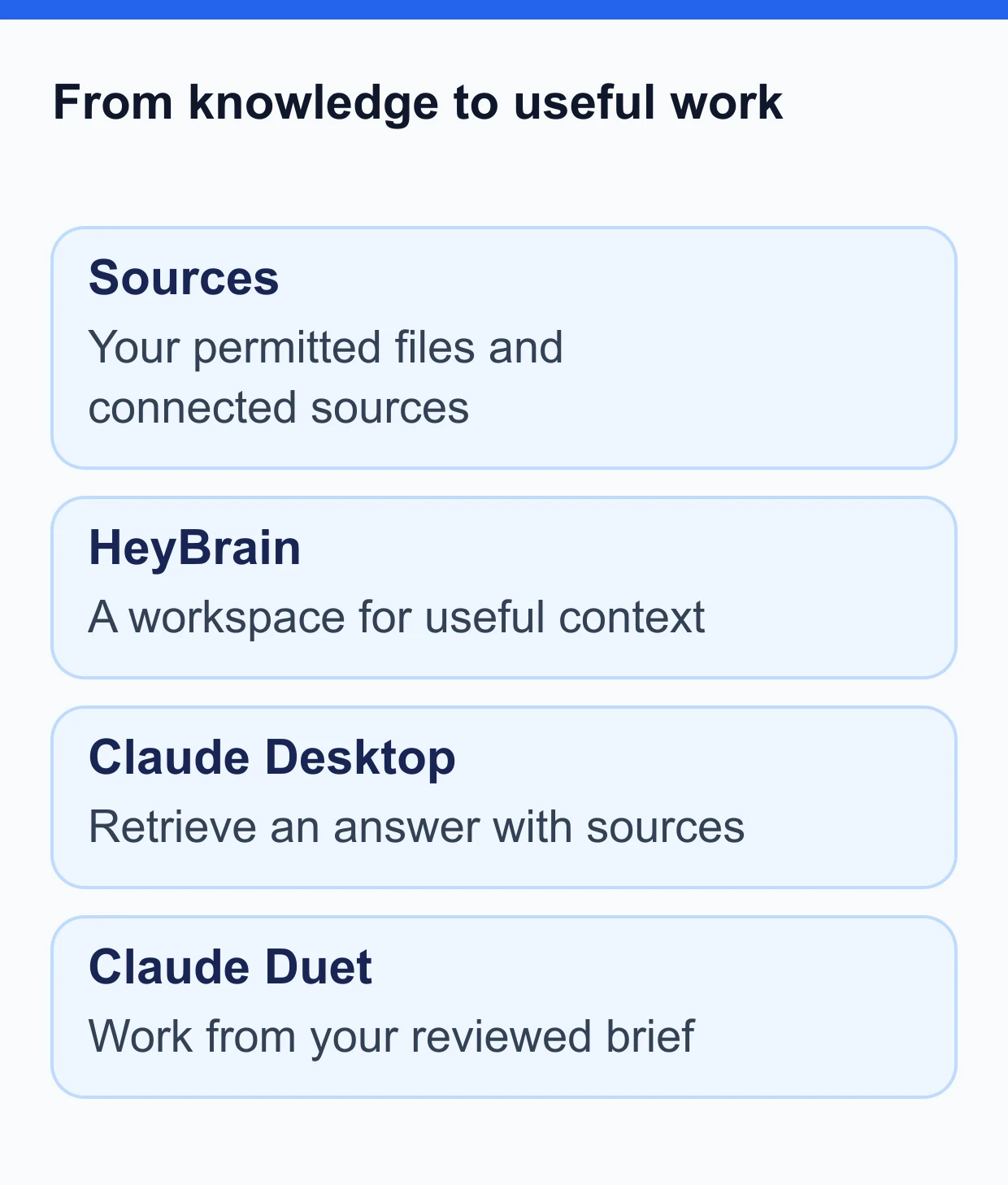
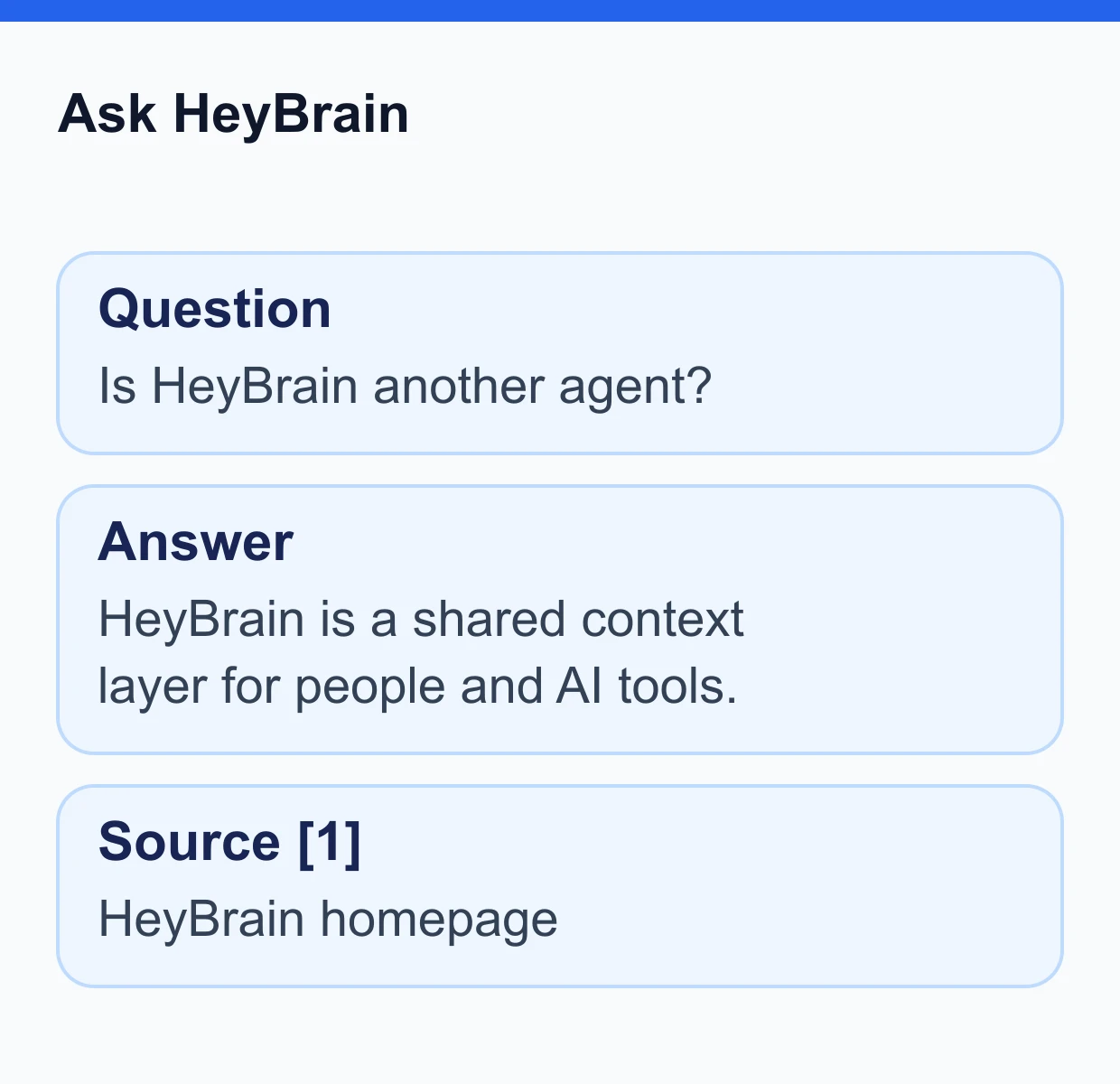
HeyBrain is the shared context layer for your AI workforce. It gives people and supported AI clients a knowledge workspace to read from; it is not a fifth agent in this comparison. The useful combination is source-backed context followed by action: establish the relevant knowledge in Claude, then hand Duet a brief it can work from.
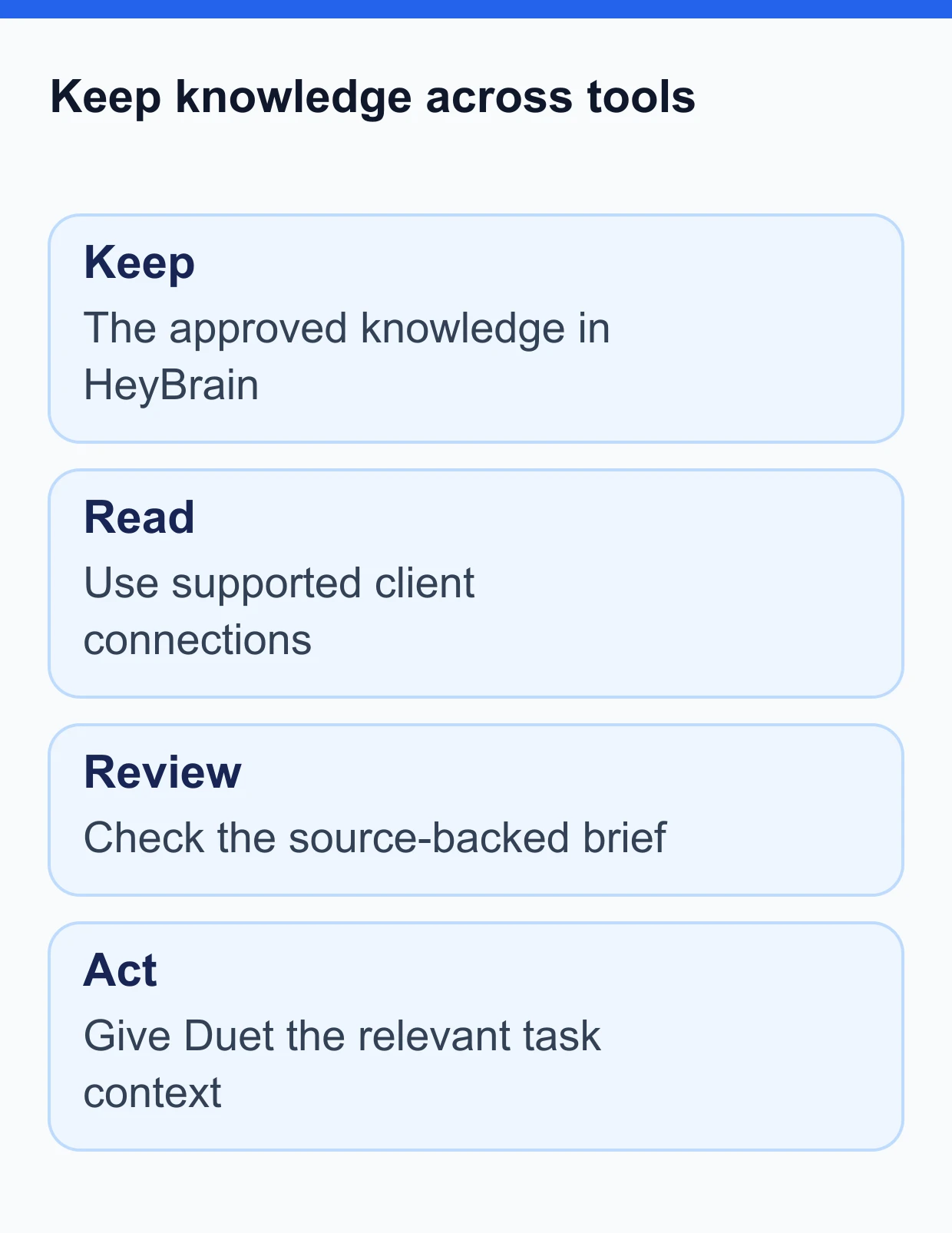
Connect HeyBrain to Claude through the documented Claude Desktop path. Ask Claude for a brief grounded in your permitted workspace sources, open the citations and review the conclusion. Then give Duet the relevant brief and a concrete task, such as preparing a follow-up or assembling a deliverable. The knowledge step and the action step have clear responsibilities.
A shared knowledge layer helps when your approved documents need to remain useful across people, projects or supported clients. Keep source permissions and workspace audiences explicit. Connected sources and uploaded copies have different update implications, so a copied document should have its own audience and refresh process.
How can you make a useful choice in one afternoon?
Choose one representative task, give each shortlisted agent the permitted context it needs and compare finished results. Score whether the result answers the question, uses the right sources and leaves consequential choices under your control. Include the time spent correcting the output. A fast first draft is not the same as a completed piece of work.
Use a task you already understand. For a briefing, ask for the current decision, supporting source, open question and next step. For an action workflow, specify what may be prepared and what needs approval. Keep the source set comparable so one agent is not credited for information the others never received. Stop a workflow that reaches beyond the intended access.
Your shortlist should become smaller after this exercise. Keep the tool that completes the valuable task with acceptable review effort. Add HeyBrain when a maintained, shared source collection improves the context feeding that task. This is a stronger buying decision than choosing an agent because it won an unrelated benchmark or appeared first in a feature list.
Which official sources support the current details?
Meta’s small-business announcement, Japan rollout, subscription guide and current Muse page support the later business, regional, price and computer-use details.
Grok Bot’s overview, FAQ, security FAQ and subscription guide support its context sharing, model routing, controls and unified usage pool. OpenAI’s current dots guide and Anthropic’s Duet guide supply rollout and current usage boundaries.
Your next step
Choose one recurring task and the sources that can make it better. Keep the knowledge in a HeyBrain workspace, use Claude to turn it into a source-backed brief, and give Duet a clear task to carry forward.
Frequently asked questions
What is Claude Duet?
Claude Duet is Anthropic’s proactive agent research preview, announced October 21, 2026. It brings Claude-account memory, skills and connected apps into an ongoing workflow with briefs and background tasks. Invited US Pro and Max subscribers are the initial audience; Team and Enterprise are not included in that preview.
Which is better, Claude Duet or dots?
Choose Duet when Claude-account continuity is the central requirement and you have preview access. Evaluate dots for work across ChatGPT, Slack and Teams or its organization rollout. Compare the same permitted task and finished result. Neither product is a universal winner for every account, app or workload.
Is Claude Duet better than Grok Bot?
Duet offers a Claude-centered workflow; Grok Bot documents coordinated Bots, persistent files and computer-based tools. The better fit depends on the task, access and controls you need. Grok Bot’s automatic model routing and organization rules also make a fixed-model comparison an incomplete way to choose.
Is there a free alternative to Claude Duet?
Muse documents a limited free tier. That gives you an entry point to evaluate its workflow, not a promise of the same allowance or business capability as another subscription. Duet itself is included with eligible invited Claude Pro and Max accounts during its preview rather than offered as a generally available free plan.
Do these agents share memory with each other?
The four vendors do not establish one common cross-vendor memory. That differs from saying none shares context: Grok Bot documents groups and handoffs, while dots spans channels and organization routes. HeyBrain provides a separate knowledge-layer option for supported clients when a shared source collection serves your work.
Is Claude Duet the same as Duet AI?
No. Claude Duet is Anthropic’s proactive agent. Google’s former Duet AI name belongs to a different product history. Keep the maker and current product name explicit when following setup instructions, comparing pricing or deciding which account and connected apps a service can use.