


Claude Duet vs HeyBrain: What Each Does, and Why Teams Use Both
Claude Duet does work in your connected apps; HeyBrain supplies shared, permission-aware knowledge to people and supported AI clients. Use Duet for the task and HeyBrain for the source context. Together, a source-backed brief in Claude can become a better-defined job for Duet, with the evidence and action responsibilities kept clear.
- HeyBrain is a knowledge layer, not another agent that books, pays or sends for you.
- Duet’s preview carries Claude-account context and is not on Team or Enterprise plans.
- Retrieve and review the brief in supported Claude Desktop, then give Duet the task context.
Contents


Claude Duet
Agent and knowledge roles
What does each product do?
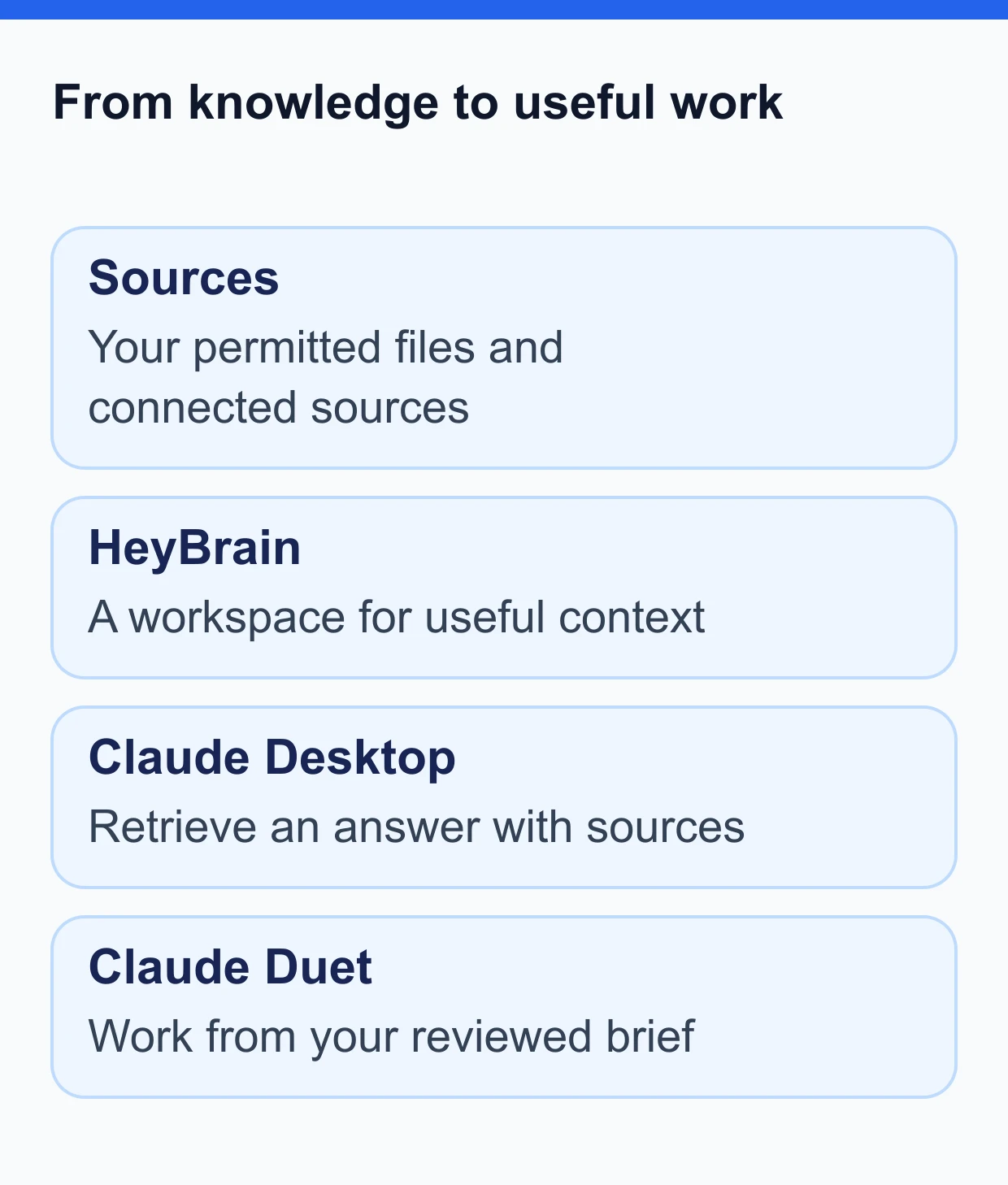
Claude Duet is an agent that advances work in connected apps. HeyBrain is the shared context layer for your AI workforce: knowledge that people and supported AI clients read with the relevant permissions. One helps carry work forward; the other gives that work a maintained source of context. A good workflow makes both responsibilities explicit.
Think of a client follow-up. The action might be a draft message, a calendar change or a document prepared for review. The knowledge behind it includes the agreed scope, latest delivery decision and source of a promise. An agent can prepare the action, while the source-backed brief determines what it should say and which questions remain open.
| Question | Claude Duet | HeyBrain |
|---|---|---|
| What it is | Proactive agent app | Shared context layer |
| What it does | Briefs, drafts and advances tasks in connected apps | Makes permitted workspace knowledge available to people and supported clients |
| Starting context | Claude-account memory, skills, connected apps and eligible chats | The selected workspace’s sources and documents |
| Team support | Preview not on Team or Enterprise plans | Workspace knowledge and access are a separate product boundary |
| Actions | Agent tools with consequential-action approvals | Permission-scoped knowledge and document tools |
| Alongside workflow | Works from the task brief you give it | Supplies source-backed context through supported Claude access |
Anthropic’s Duet announcement describes the agent’s preview workflow. HeyBrain’s Claude connection guide gives the supported Claude Desktop route, and its MCP reference describes available knowledge tools.
When is Claude Duet alone enough?
Duet alone can be enough when the task’s important context already lives in Claude and the apps connected to your account. A morning brief from email and calendar does not automatically need a second knowledge service. Start with the information the task actually requires and evaluate whether the resulting work uses it well.
For one professional managing a familiar set of conversations, account continuity can be valuable. You can hand over a task in the ongoing thread and receive a result or a decision request later. Duet’s own context may already contain the preferences and recent exchanges needed for that job. Another system should solve a specific missing-context problem.
You can recognize an adequate workflow by its output. A useful brief identifies the commitment, date, person who needs to decide and the source of the information. It does not merely summarize every message. If the task already reaches that standard, adding another store may create maintenance work without improving the decision.
When is HeyBrain alone enough?
HeyBrain alone can be enough when the immediate need is to find and use shared knowledge in an AI client you already work with. The missing result might be an answer with sources, a concise project brief or a clear record of what changed. None of those necessarily requires a proactive agent to send or buy anything.
A team preparing a sales call often needs the current product answer, approved positioning and relevant account notes. A source collection that colleagues can retrieve through their supported clients addresses that need directly. The value is being able to find the same approved information and inspect its support, rather than ask every colleague to reconstruct it from memory.
This also helps an individual who switches between tasks or supported clients. Keeping the useful source in a knowledge workspace means it does not depend on which conversation happens to be open. You still maintain the source and decide who may read it. Persistent storage is useful because the information is organized and retrievable, not simply because more text has been saved.
Why do teams use an agent and a shared context layer together?
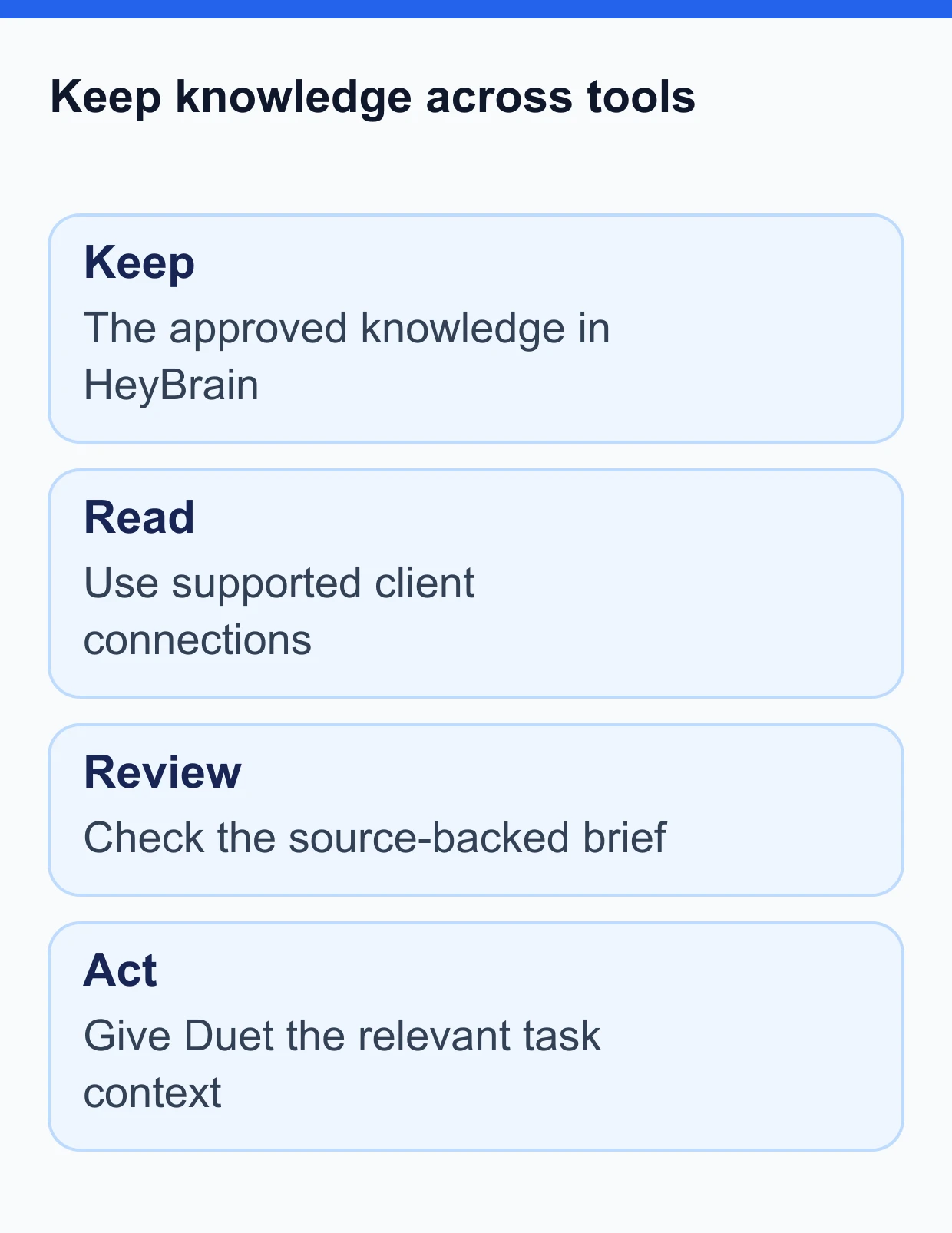
Teams need both useful information and a way to carry work forward. A source-backed brief connects those needs: HeyBrain supplies the permitted knowledge through Claude, a person reviews the important facts, and Duet works from that brief. This avoids asking an action-oriented task to reconstruct the team’s history from scattered messages.
For a project update, the source collection might contain the latest decision, delivery notes and a customer-facing summary. Claude can turn those records into a brief that separates confirmed scope from an unresolved date. Duet can then prepare the follow-up and bring the action back for approval where required. The supporting information stays visible rather than becoming an unsupported sentence in a draft.
The same pattern works for a founder preparing a meeting or a consultant moving between clients. The maintained knowledge is the foundation; the task brief is the handoff. Keep the brief relevant to the requested action instead of copying an entire workspace into every task. That makes the result easier to review and helps preserve the boundary between projects.
How does the alongside workflow work?
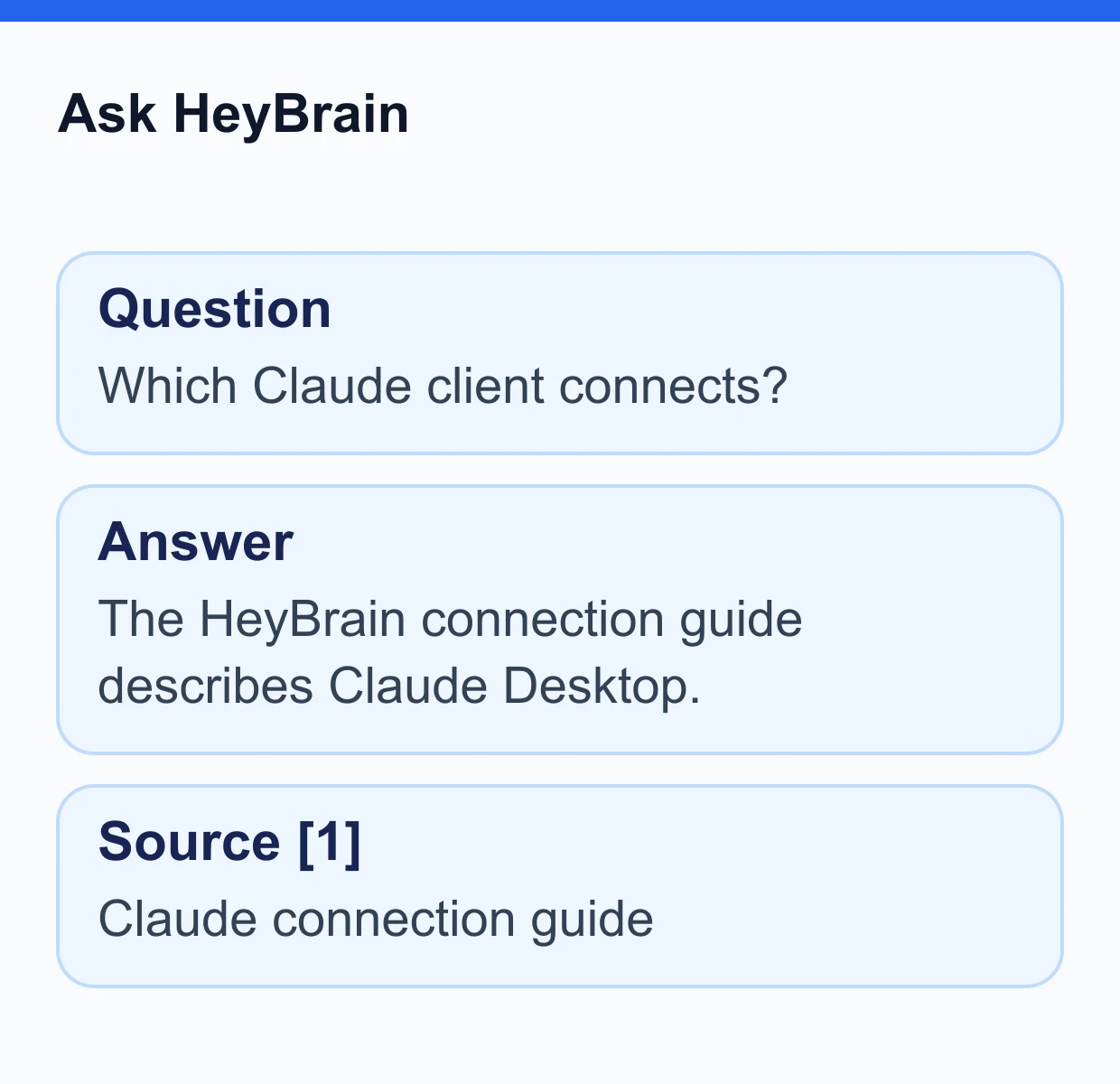
Use the documented HeyBrain connection in Claude Desktop to retrieve the context, then carry the reviewed brief into Duet for the action. That is the alongside workflow. It does not require treating HeyBrain as an agent or assuming the task tool and the knowledge client have identical interfaces. Each step has a clear result.
First, choose a permitted workspace and ask Claude a question tied to a source: what was decided, what supports it and what is still open. Open the citations and check the passage behind any promise, deadline or permission. Next, turn the answer into a short brief with the task’s goal, confirmed facts and review boundary. Give Duet that brief and the work to advance.
A good handoff might ask for a follow-up draft that uses the agreed scope, leaves the unconfirmed date open and waits for approval before sending. It tells the agent what to accomplish without quietly granting broader account access or action authority. A source-backed brief should make a task more specific, not turn every retrieved sentence into an instruction.
What changes when the source changes?
When the underlying source changes, refresh the brief before you reuse it for another action. The knowledge layer and the agent task are different records. A completed brief can become outdated even when it was correct at the time. Make the source date and the unresolved point easy to identify so the next person knows what needs another look.
Connected sources and uploaded copies need different update expectations. An uploaded copy is managed separately; its original Drive or Notion permissions do not automatically synchronize. Decide the workspace audience and how the copy will be refreshed. For a connected source, understand the particular connector’s update and access behavior rather than promise universal synchronization.
This is useful operational discipline for a team. A document owner can update the canonical decision, the next brief can cite the current source and the action owner can review the resulting work. You do not need to claim that every competitor lacks memory or governance to explain the benefit of a maintained source collection.
How should you decide what to adopt?
Adopt the missing capability first. If you need a task advanced across connected apps, evaluate Duet. If you need source-backed answers from a maintained knowledge collection, evaluate HeyBrain with a supported client. If both are missing, start with one complete source-to-brief-to-action workflow and judge the finished result.
Keep the scope small enough to review. Choose one recurring decision, a few approved sources and an action with a clear approval point. Record the time needed to find the information, correct the brief and finish the work. This reveals whether the combination removes an actual bottleneck or simply moves it to a new interface.
Duet and HeyBrain solve different parts of the job. The practical verdict is straightforward: use Duet to carry a clear task forward, and use HeyBrain to make the context feeding that task easier to retrieve, inspect and reuse. The shared knowledge guide develops the benefits in more detail.
Your next step
Choose one recurring task and the sources that can make it better. Keep the knowledge in a HeyBrain workspace, use Claude to turn it into a source-backed brief, and give Duet a clear task to carry forward.
Frequently asked questions
Is HeyBrain an alternative to Claude Duet?
They solve different parts of a workflow. Duet advances tasks in connected apps. HeyBrain supplies a maintained knowledge workspace to people and supported clients. Choose the capability you need first, then combine them when source-backed context makes the agent task more useful.
Can a team use Claude Duet?
Anthropic’s research preview is for invited US Pro and Max subscribers, not Team or Enterprise plans. An individual can use it for work, but that is not the same as a centrally administered team deployment. Keep the knowledge audience and each person’s task access explicit.
Does Claude Duet share all my team’s knowledge?
Duet carries the Claude-account context and connected information described by Anthropic. A team’s broader knowledge still needs an intended source collection, audience and retrieval path. HeyBrain can supply that collection through supported clients, and a reviewed brief can carry relevant context into a Duet task.
Can I use HeyBrain and Claude Duet together?
Yes, as complementary parts of a workflow: use HeyBrain with supported Claude Desktop to retrieve and review the source context, then give Duet the relevant brief and task. HeyBrain supplies knowledge; Duet uses its own tools to advance the work and seek required approvals.
Does HeyBrain take actions like Duet?
HeyBrain’s knowledge and permission-scoped document tools are different from an agent’s app actions. Supplying a source-backed answer does not authorize a purchase, outgoing message or account change. Keep the agent’s action permissions and approval requirements separate from the knowledge it can read.
Do uploaded documents keep their source permissions?
Uploaded copies are managed separately from their original source. Do not assume that the original Drive or Notion permissions and updates automatically synchronize with a workspace copy. Choose its intended audience and refresh process, and distinguish that workflow from a connected source’s particular behavior.