

Claude Duet as Your Second Brain: What It Remembers, What It Forgets and How to Fill the Gap
Claude Duet remembers through your Claude-account context, connected apps and eligible past chats. Your notes, readings and files need their own organized source collection. Use a personal HeyBrain workspace alongside Claude and Duet: retrieve a source-backed brief in Claude, review it, then give Duet the context for the work you want done.
- Duet’s memory is useful continuity, not automatic access to every project and local file.
- Start with one personal task and a small permitted source collection.
- Keep your knowledge current and separate from the brief used for one agent task.
Contents


Claude Duet
Your notes and useful context
What does Claude Duet remember?
Duet remembers through Claude-account memory, skills, connected apps and eligible past-chat search. That continuity can make ongoing work easier, but it is not the same as a complete personal archive. Your notes, readings, PDFs and project records need an intended source path if you want them to inform the work.
Anthropic describes search across Duet chats and Claude conversations outside projects. It also lists limitations on project content and local computer files. Start by asking where the information lives, rather than whether the assistant sounds familiar with your preferences. A remembered preference and a current source document do different jobs.
| What supplies context | What it means for your own work |
|---|---|
| Claude memory and skills | Preferences and saved account context can carry over |
| Duet and eligible Claude chats | Past-chat continuity is useful, but not universal project access |
| Connected apps | Information depends on the accounts and access you connect |
| Cloud computer | Background work does not mean blanket access to your local files |
The official Duet guide describes those boundaries. A personal AI second brain is a system for keeping and reusing knowledge in your own work. It succeeds when you can find and apply the useful source, not simply when you have accumulated a large archive.
Which of your sources should come first?
Start with the sources needed for one recurring outcome: a client brief, a study session, a research note or a piece of content. A small collection gives you a clear question to ask and a result you can judge. Importing everything at once makes it harder to see which information is useful, outdated or missing.
For a freelancer, the first collection might be the approved project scope, relevant call notes and current open questions. Keep each client’s work separate according to its intended audience. When you prepare the next brief, the aim is to retrieve the right context without blending an old promise from another project into the answer.
For a student, start with permitted readings, your own notes and the questions you are trying to understand. Keep the source title and date so you can return to the original argument. Ask for a comparison or explanation grounded in that collection rather than a generic summary of the subject.
For a creator, organize a small body of past work by the ideas you want to reuse. Keep the published source and the point it supports. A useful research brief can distinguish a recurring theme from a new claim that still needs support. This gives the next task a better starting point without asking an agent to invent a history of your work.
How do you turn stored material into useful context?
Turn stored material into useful context by preserving what it says, where it came from and why it matters to the task. A document title alone may not explain the decision you need to make. Keep confirmed facts, your interpretation and unresolved questions distinct so the next answer does not collapse them into one confident conclusion.
For a project record, write the decision and its status next to the supporting source. For a reading, keep the claim you want to revisit and the passage that supports it. For your own notes, retain enough context to understand a shorthand sentence later. These small choices make retrieval more useful than a folder of unexplained fragments.
Then ask a specific question. “What changed in the agreed scope?” is more useful than “tell me about this project”. “Which two readings disagree on this point?” gives an explanation a clear source boundary. A focused question helps Claude retrieve and organize relevant context before you hand Duet a task.
How does HeyBrain fit alongside Claude and Duet?
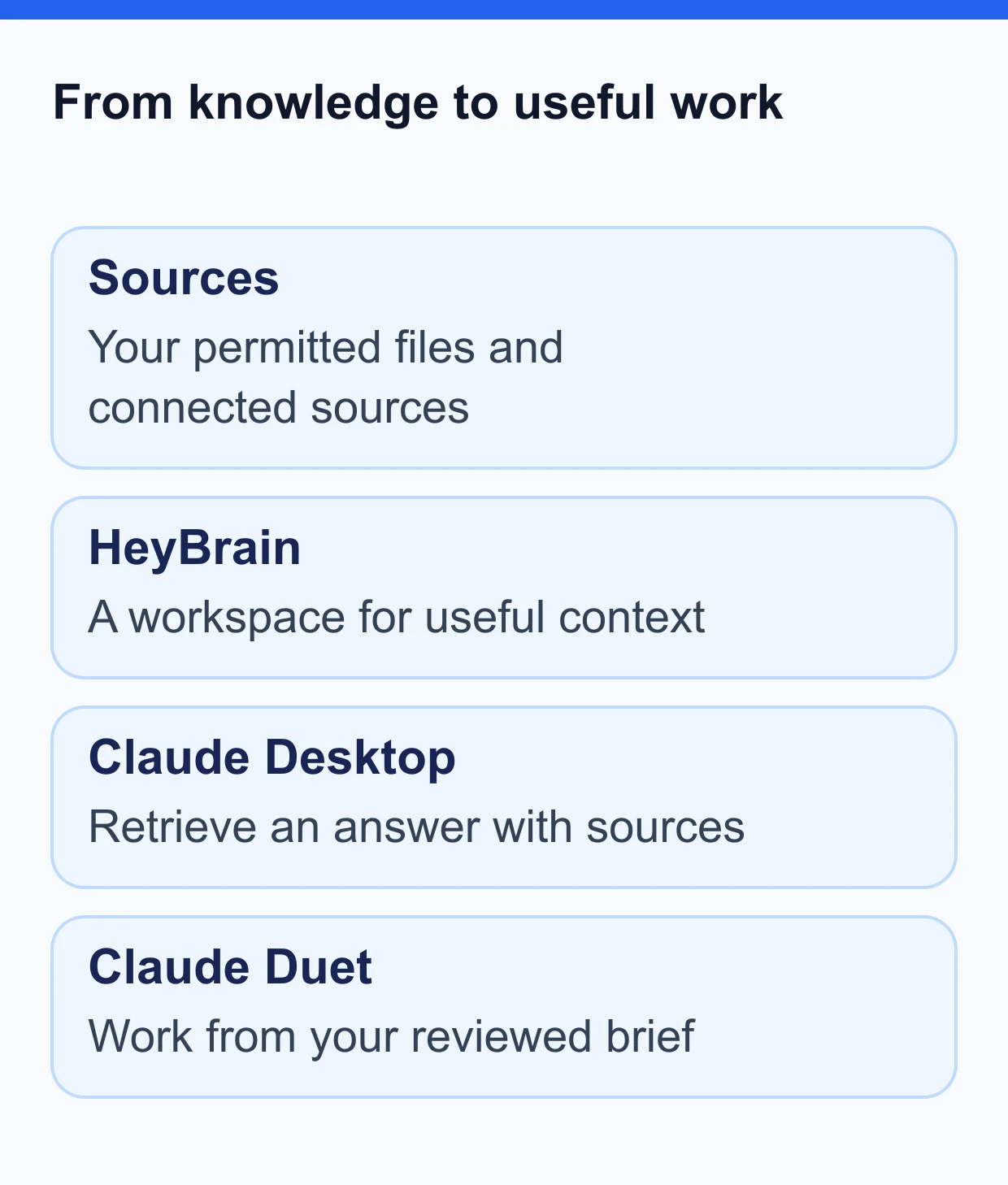
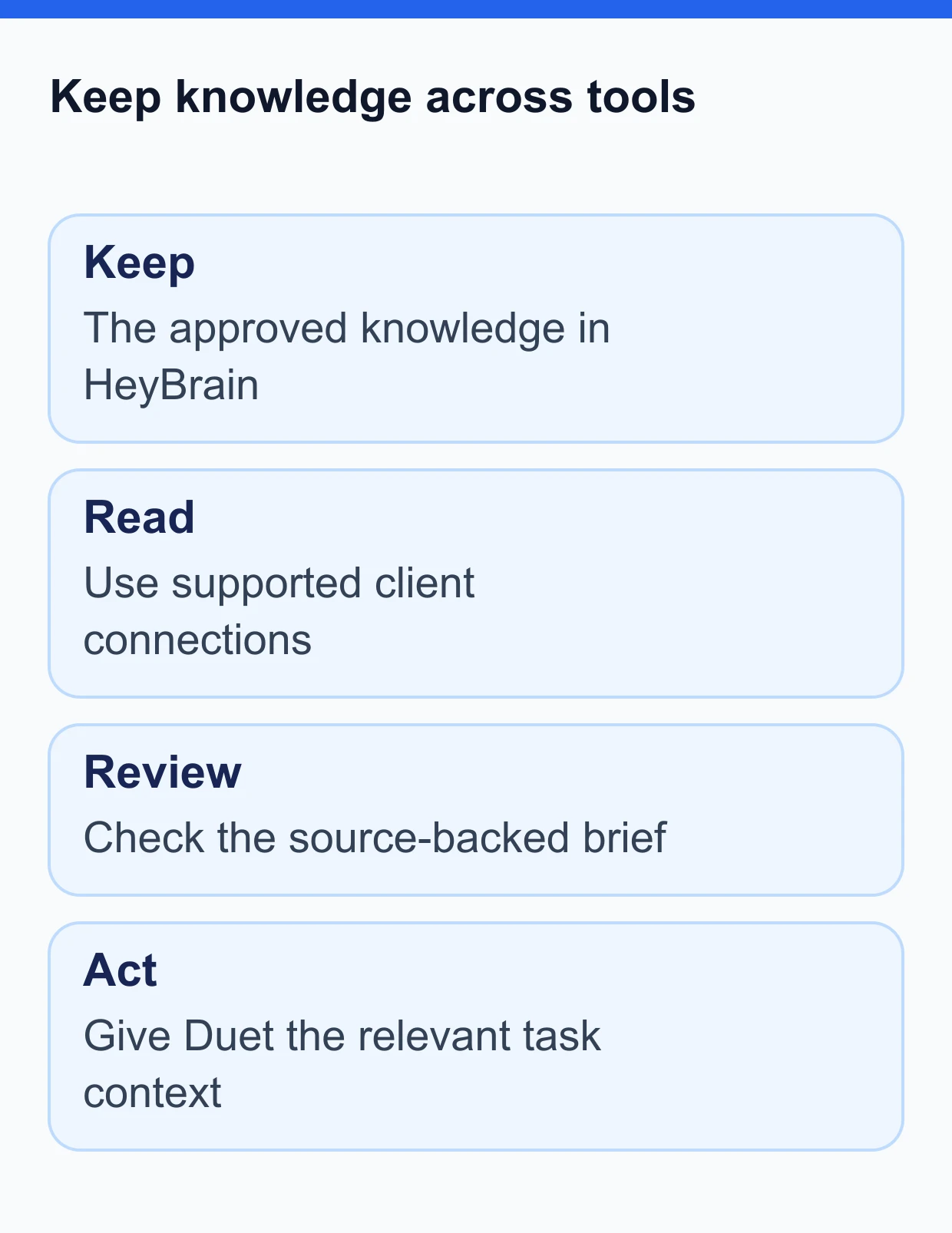
Use a personal HeyBrain workspace to maintain the knowledge collection, Claude to retrieve and review a source-backed answer, and Duet to advance the task from your brief. The supported Claude Desktop connection provides the knowledge step. You decide which relevant context to carry into the Duet task and which action needs your review.
The starting sequence is short: sign up, add the files and notes you are allowed to use or connect a supported source, then follow the HeyBrain Claude guide. Ask Claude for a brief with citations, open the supporting material and give Duet the task. The shared knowledge guide explains the broader benefits without turning the knowledge service into another agent.
A personal brief might contain the current goal, three supported points, an unresolved question and the next result you want. Duet can use that context for a draft or deliverable. The point is not to repeat the entire collection in every message, but to provide the information that makes this particular task well defined.
What can this change in your everyday work?
A maintained personal knowledge collection can reduce the work of reconstructing context before every task. You can return to the source when a question recurs, carry a concise brief into a new conversation and distinguish current information from an old note. That makes continuity a deliberate practice rather than a hope that an assistant remembers every detail.
Before a client call, retrieve the agreed scope and the question still awaiting an answer. Before a study session, compare the relevant readings and identify the passage you need to revisit. Before drafting an article, gather the supported claims and leave new assertions separate. In each case, the knowledge step improves the task you can hand to the agent.
The result should stay useful even when you switch conversations. Your collection remains the source record, while a brief serves a particular task. Keep the source reference with the brief so you can check it later. An agent’s polished wording should not become the only surviving record of what a document actually said.
How do you keep your knowledge current?
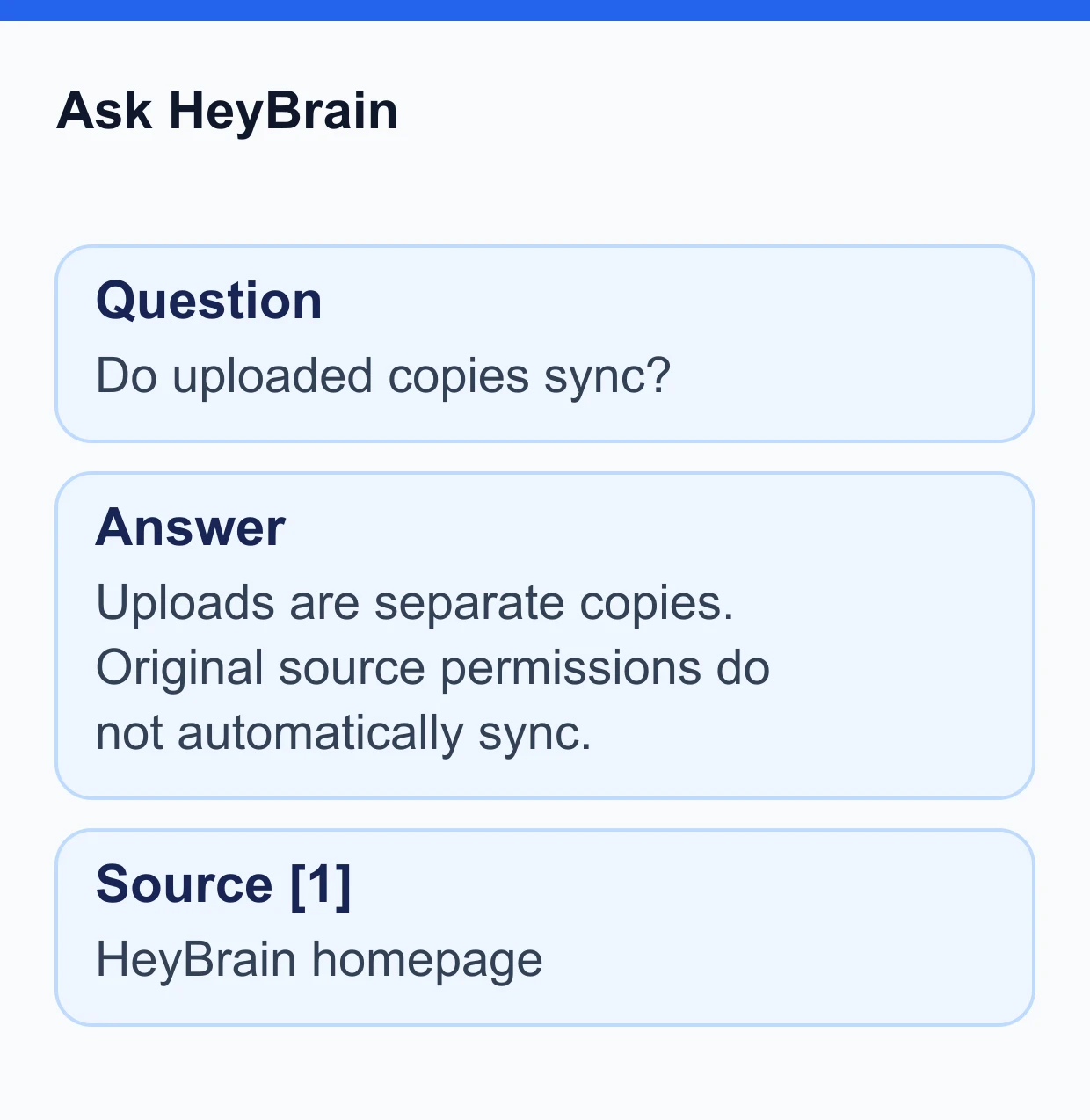
Keep your knowledge current by deciding which record is authoritative and how changes reach the collection. Connected sources and uploaded copies have different behavior. An uploaded copy is managed separately; it does not automatically receive the original Drive or Notion permissions or every later source change. Give it an audience and a refresh rule.
For a recurring project, review the collection when the work changes: a scope decision, a new reading or a revised position. Make the current status clear and retire outdated guidance deliberately. Keep provenance where it helps explain why the answer changed. This prevents an old note from looking like a fresh instruction simply because it was retrieved recently.
Keep personal and company material in separate collections with the appropriate audience. A convenient single search is not worth an unintended disclosure. Add only material you are entitled to use, and consider whether a source is appropriate for the tool and task receiving the brief. Knowledge organization and access decisions belong together.
What is the difference between memory and a second brain?
Memory helps an assistant carry context from prior interactions. A personal second brain is a broader practice of keeping and reusing sources for your own work. The two can complement each other: saved preferences support continuity, while a maintained collection provides documents you can retrieve and inspect when a task needs evidence.
A second brain does not need to preserve every conversation. Keep what another task is likely to need: the source, useful interpretation, current decision and open question. A smaller collection with a clear purpose can be easier to review than a large archive whose audience and update behavior are unclear.
Duet can carry work forward, while your knowledge collection remains useful beyond the task. The best starting point is one outcome you want to improve, not a promise to remember everything forever. Build the source collection around that outcome and judge whether the finished work becomes easier to prepare and review.
What should you try first?
Choose one task you repeat each week and prepare a brief from three relevant sources. Ask Claude to identify the supported facts, source links and unresolved question. Review that brief, then give Duet a bounded task such as preparing a call outline or follow-up draft. Keep the action’s approval boundary explicit.
After the result, note which source was useful and what information was missing. Improve the collection for the next run rather than add unrelated material. If usage becomes the constraint, the Duet pricing and usage guide helps separate the capacity decision from the knowledge-design decision.
Your next step
Choose one recurring task and the sources that can make it better. Keep the knowledge in a HeyBrain workspace, use Claude to turn it into a source-backed brief, and give Duet a clear task to carry forward.
Frequently asked questions
Can Claude Duet be a second brain?
It can support continuity through the Claude context and connected information Anthropic describes. A personal second brain also needs a maintained source collection for the material you want to reuse. Combine the two deliberately: retrieve the relevant knowledge, review the brief and hand the agent a clear task.
Does Duet remember my notes?
That depends on where the notes live and which source route makes them available. Do not treat a remembered preference as proof that every note is accessible. Organize the permitted material in a knowledge collection and use the supported client workflow to retrieve the context the task needs.
Does Duet see my Claude projects?
Anthropic describes past-chat search outside projects and lists limitations on project content and local files. Keep the needed source path explicit. For the alongside workflow, retrieve the relevant context in Claude through HeyBrain, review its support and give Duet the brief for the particular task.
How do I give Duet my own knowledge?
Keep your sources in a personal HeyBrain workspace, connect HeyBrain to supported Claude Desktop and ask for a source-backed brief. Review the citations and carry the relevant context into Duet with a concrete task. The knowledge collection remains separate from the action and its required approval.
Is HeyBrain a notes app?
HeyBrain is a knowledge layer for people and supported AI clients. Keep the writing or note-taking tool that suits your own work, then decide which permitted sources belong in a reusable knowledge collection. The goal is useful retrieval and context, rather than replacing every editing or offline feature of a notes app.
Should I upload everything I have?
Start with the material needed for one recurring outcome. A smaller collection makes relevance, missing information and stale sources easier to see. Keep each source’s intended audience and update process clear, and separate personal material from company collections before using the resulting brief in an AI task.