

Claude Duet Pricing and Usage Limits: How to Make Pro or Max Go Further
Claude Duet is included with eligible invited Claude Pro and Max accounts during the research preview. It shares the same usage limits as your Claude chats, including the work it does in the background. Make Pro or Max go further by choosing relevant routines, scoping large tasks and giving the agent a focused brief from your own knowledge.
- Pro is $20 monthly or $200 annually; Max starts at $100 monthly.
- Duet, background checks and ordinary Claude work share the plan allowance.
- Choose capacity from useful completed work, not a count of requests.
Contents

Claude Duet
Understand shared Claude usage
How much does Claude Duet cost?
Claude Duet has no separate subscription price during Anthropic’s research preview. It is included for invited Pro and Max users and uses the same Claude plan allowance. Your plan and access conditions still matter: the preview begins with US accounts, and an eligible subscription does not replace the waitlist invitation.
Compare the billing interval before deciding what a plan costs. Pro’s monthly price and annual equivalent are different presentations of different billing commitments. Max starts at a higher monthly price and offers larger usage options. The useful choice is the allowance your work needs, rather than assuming a higher tier changes every Duet feature.
| Option | Documented price | What to distinguish |
|---|---|---|
| Pro, monthly | $20 per month | Monthly billing |
| Pro, annual | $200 per year | About $17 per month as a rounded annual equivalent |
| Max | Starts at $100 per month | 5× or 20× Pro usage options |
| Duet preview | Included with eligible Pro/Max | Invitation and US preview access |
These prices come from Anthropic’s pricing page. The Duet support guide describes the shared allowance and preview conditions. New admits receive one full limit reset usable until November 30, 2026; that temporary launch benefit is different from a recurring refill.
What uses your Claude allowance?
Duet uses your Claude allowance for messages, assigned tasks and background activity. Anthropic explains that larger deliverables can involve more turns and background work. A morning brief, a presentation task and your separate Claude conversations therefore belong in the same workload estimate. They should not be budgeted as independent pools simply because the interfaces differ.
Task count is a poor substitute for workload. A short scheduling question and a detailed research deliverable may both be one request, yet require very different amounts of effort. Include the background checks and follow-up work that make a proactive agent useful. You are choosing capacity for an ongoing pattern, not a fixed number of identical questions.
| Work | Why it matters | A practical decision |
|---|---|---|
| Messages and tasks | They share the Claude allowance | State the result and relevant scope |
| Morning brief and check-ins | They add background work | Choose relevant alerts and frequency |
| Large deliverables | They can require more turns | Request the deliverable when you need it |
| Ordinary Claude chats | They use the same plan | Consider the whole week, not Duet alone |
Should you choose Pro or Max for Duet?
Choose Pro or Max by the useful work that is constrained when you reach the plan limit. A few bounded tasks each week differ from daily briefs plus frequent large deliverables. Max supplies more usage; the decision should come from that workload rather than a belief that Duet is available only on Max.
Start by describing a representative week. List the recurring brief, occasional task and large output you actually expect to use. Add your ordinary Claude work. Then note when useful tasks are interrupted and what was running. A record of completed work and interruptions gives you a more concrete upgrade decision than a broad promise of productivity.
If you rarely need the extra capacity, a higher subscription may sit unused. If valuable work repeatedly stops at the same point, a larger allowance can be worth considering. Separate this from output quality: more capacity does not fix a missing source, a vague request or an incorrect conclusion. First establish that the task produces something you can use.
How can you control background work?
Control background work by choosing the connected information and alerts that are relevant to you. Anthropic documents adjusting what you hear about and how often. Duet checks accounts at intervals, so it should support a deliberate monitoring pattern rather than be treated as a guarantee that every urgent message will be noticed immediately.
Begin with one useful brief. Decide which questions it should answer: what needs a response, which deadline changed and what decision needs your input. Remove sources that do not contribute to that result. This makes the brief easier to read as well as making the ongoing work more purposeful.
A broad instruction such as “keep an eye on everything” leaves the agent to infer too much about priority. A bounded request identifies the relevant account, condition and action boundary. You can ask for a draft or a recommendation while retaining the decision to send. That improves the relationship between the work performed and the result you actually need.
How should you scope a larger task?
Scope a larger task around a finished result and an early decision point. A full deck or model can use substantial work before you discover that the starting assumptions were wrong. Ask for the outline, required sources or open questions first when those decisions will determine whether the larger deliverable is useful.
For a research brief, define the question, audience, relevant period and sources. For a presentation, decide what the audience needs to understand before asking for every slide. For a comparison, identify the options and decision criteria. These choices do not remove the need for model work, but they make the work less likely to pursue the wrong outcome.
Keep revisions specific. “Make it better” can restart a broad exploration, while “retain the first three findings, correct the date from this source and shorten the recommendation” gives the next pass a clear scope. Review important facts before asking for another polished format. Formatting an unsupported claim more attractively does not make it more useful.
How does a personal HeyBrain workspace fit?
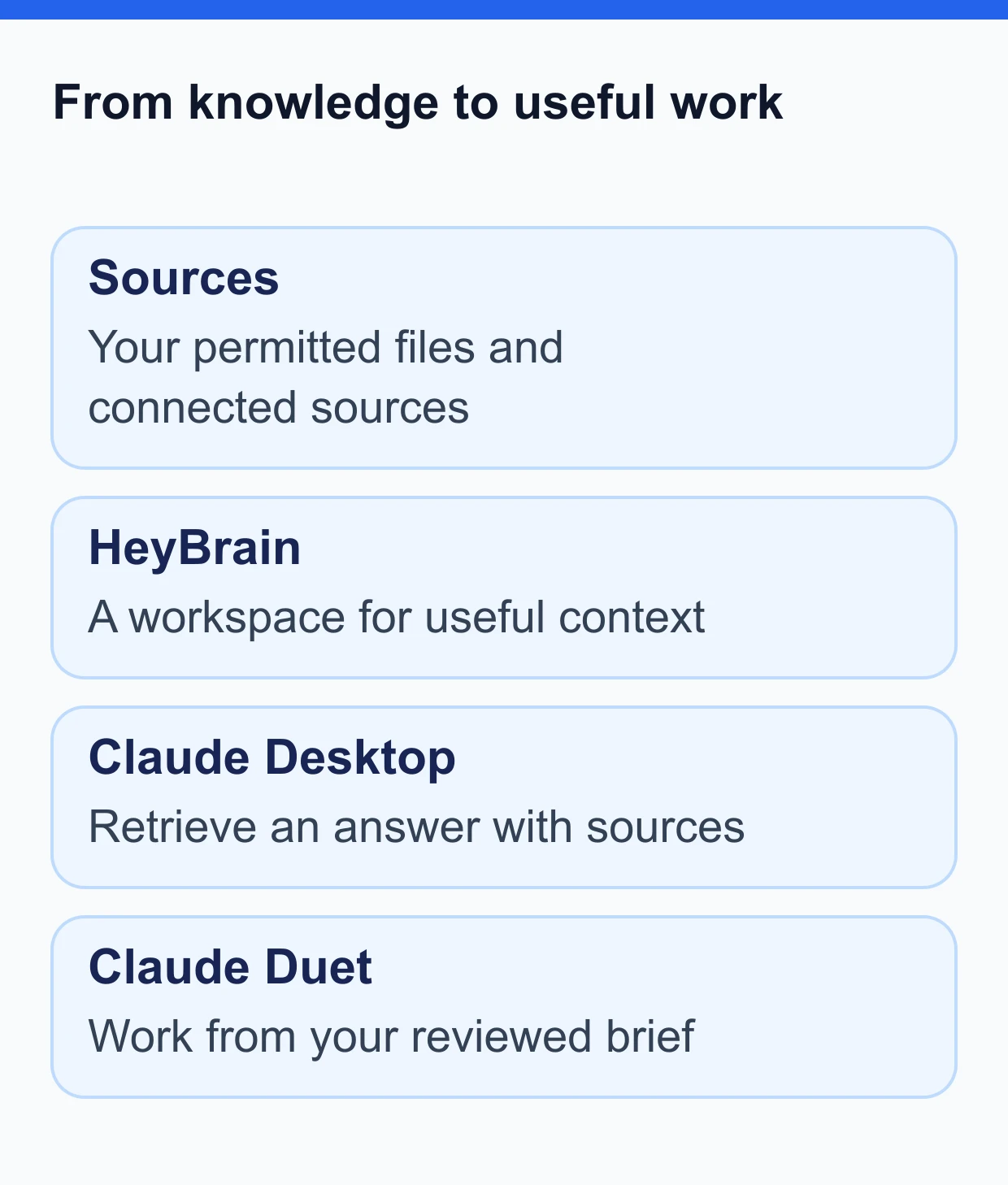
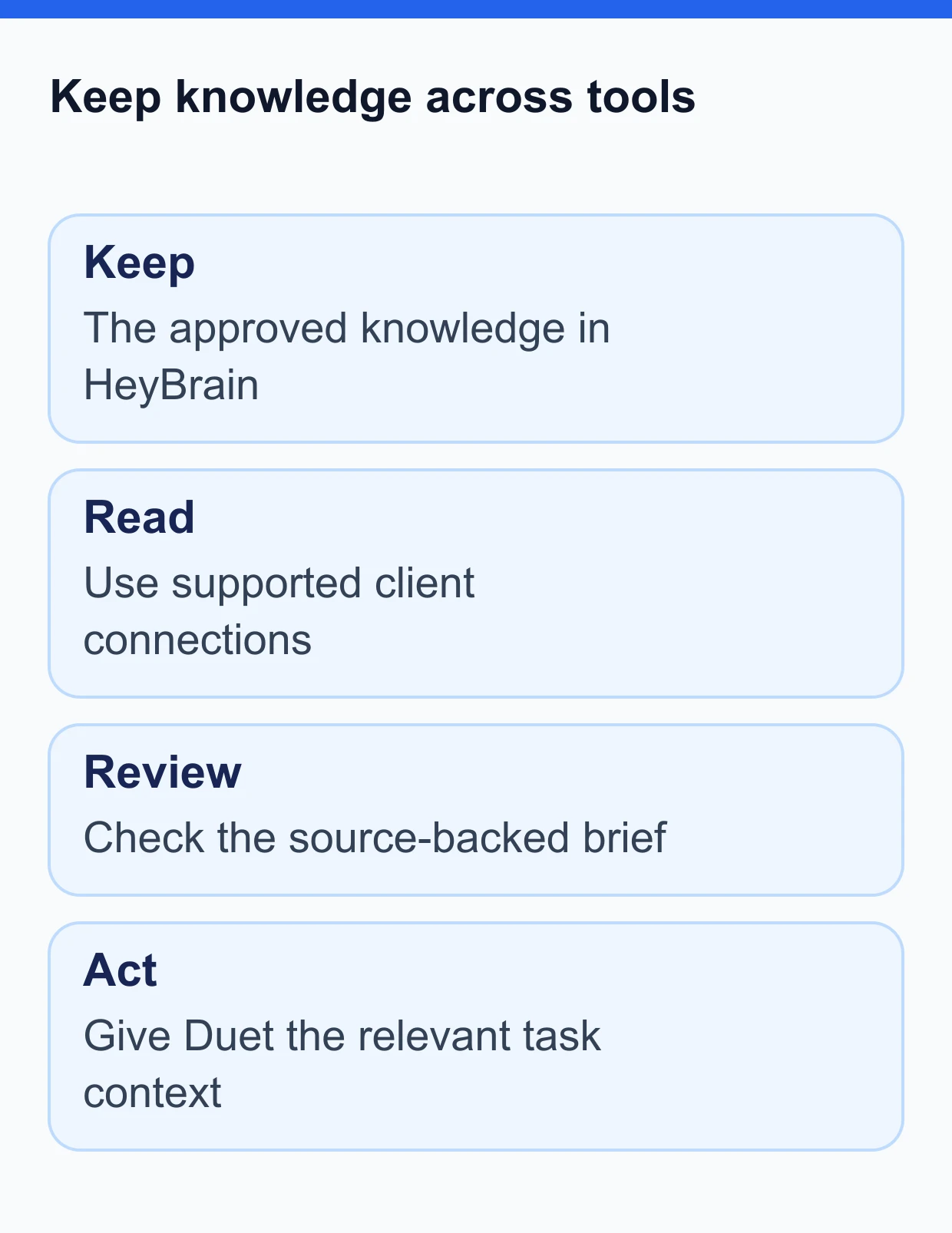
A personal HeyBrain workspace gives your reusable knowledge a place that supported clients can retrieve from. That helps when you repeatedly assemble the same notes, documents and references before asking Claude to work. Use Claude to produce a source-backed brief from the relevant collection, then give Duet that brief and the task you want advanced.
Start with a small collection tied to recurring work. For your own research, keep the source, date and point worth reusing. For a client project, keep the approved scope and open question separate. Retrieve what the task needs rather than pasting unrelated projects into every conversation. The benefit is a more deliberate context workflow, not an unlimited Claude allowance.
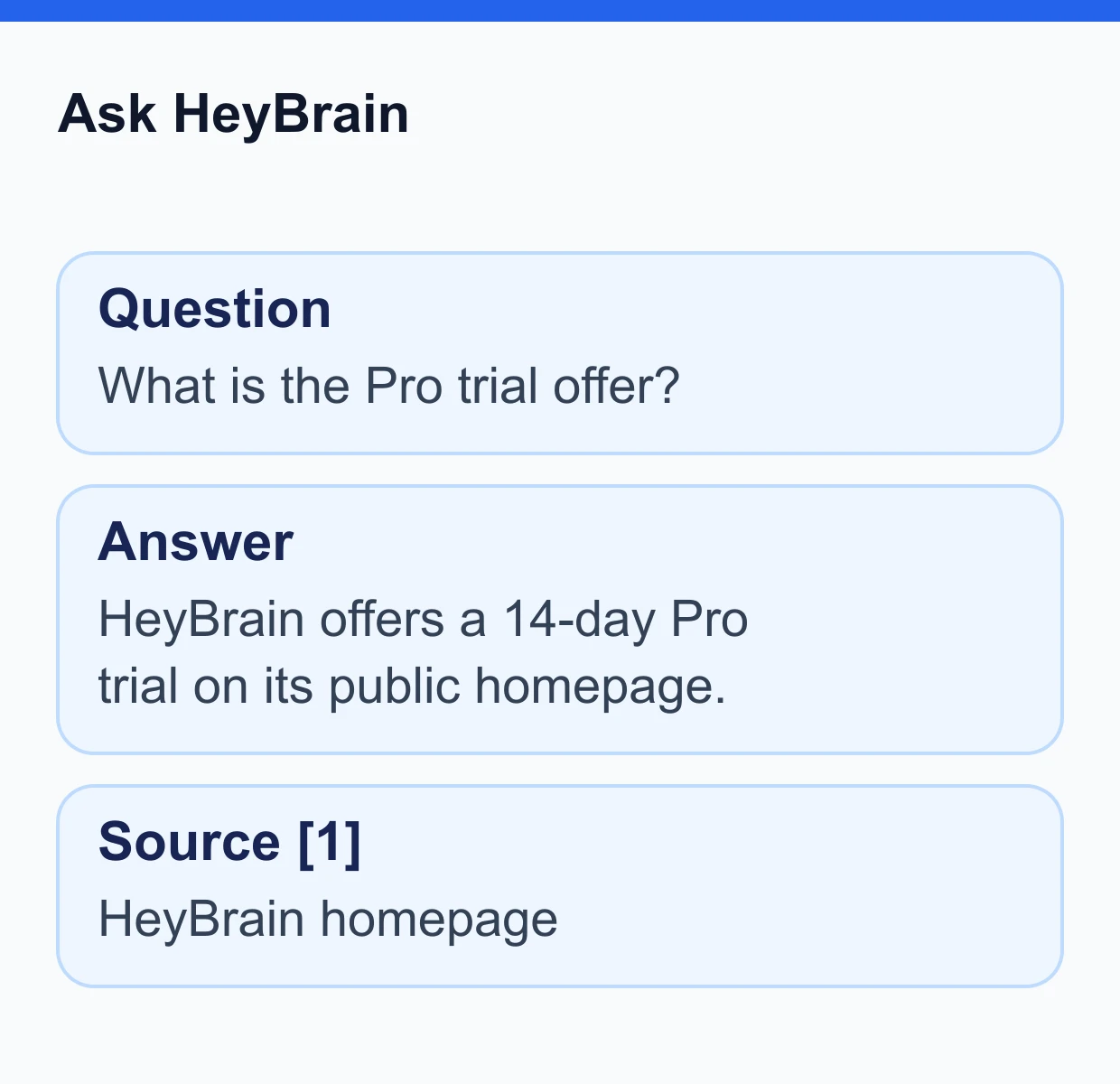
Keep the two buying decisions distinct. Choose Claude capacity for the work you perform, and choose a knowledge workspace for how you organize and reuse sources. HeyBrain’s current public offer is a 14-day Pro trial. Use it to evaluate whether a maintained source collection improves your own workflow, rather than assume another subscription automatically reduces the first bill.
Is Claude Duet worth it for one person?
Claude Duet is worth evaluating when it can reliably move useful work forward through the accounts you choose to connect. Judge the result against the effort of briefing, reviewing and correcting it. A proactive assistant that produces a readable draft but needs extensive repair may not save you work on that particular task.
Choose one outcome you can recognize: a meeting brief that surfaces the right decision, a follow-up draft grounded in the current agreement or a deliverable ready for your final review. Count the time after the first draft as well as the time before it. Keep the task only if the overall workflow is useful.
Plan price is one part of that decision. Access, source quality, review effort and the amount of useful work you can complete matter too. Muse has a limited free tier and paid options; Grok Bot has paid individual tiers; dots has eligible plan routes. The agent comparison separates those offers without treating the lowest entry price as a universal winner.
What should your first week tell you?
Your first week should tell you which tasks deserve to become routines, which need a better brief and which are not worth continuing. Keep a small log of the task, useful result, review effort and any interruption. It is enough to reveal a pattern without turning every interaction into a formal experiment.
If a routine brief is valuable but too broad, narrow the sources and questions. If large work is valuable but often constrained, compare the appropriate Max allowance. If the same context keeps needing to be reconstructed, organize that knowledge once and retrieve a focused brief. These are different problems with different solutions.
Your next step
Choose one recurring task and the sources that can make it better. Keep the knowledge in a HeyBrain workspace, use Claude to turn it into a source-backed brief, and give Duet a clear task to carry forward.
Frequently asked questions
How much does Claude Duet cost?
It has no separate subscription fee during the research preview. Eligible invited Pro and Max users receive it as part of their Claude plan. The checked pricing page lists Pro at $20 monthly or $200 annually, and Max starting at $100 monthly. Preview access conditions still apply.
Is Claude Duet free?
Duet is included without an additional fee in eligible invited paid Claude accounts. That is different from a generally available free Duet plan. The preview begins with US Pro and Max subscribers and requires a waitlist invitation; the subscription and the rollout are separate parts of access.
Do I need Claude Max for Duet?
No. Anthropic lists Pro and Max as eligible preview plans. Choose Max when the larger allowance fits the useful work you want to complete, rather than assume it is the only way to use Duet. Invitations and regional preview conditions still determine access.
Does Duet use my normal Claude limits?
Yes. Anthropic says Duet uses the same Pro or Max allowance as other Claude work. Messages, tasks and background activity belong in the same workload estimate. A separate app interface does not establish a second independent usage pool for your ordinary Claude conversations.
Why can a large task use more allowance?
A larger deliverable can require more model turns and background work. Ask for the outline, missing sources or key decision first when those choices determine the result. A clearer scope helps the agent work toward the deliverable you need rather than polish a result built on the wrong assumptions.
How can HeyBrain help me reuse my own knowledge?
HeyBrain gives your reusable sources a maintained workspace. Use supported Claude access to retrieve the context needed for a task, inspect its sources and prepare a focused brief for Duet. This helps you reuse the relevant knowledge across work instead of reconstructing the same background before every request.