

Introducing Company Brain
Contents


Company Brain
Now open to everyone
For the last 4 months, almost everything our team ships has passed through a Brain.
Not a shared drive. Not a wiki nobody updates. A single governed layer holding our strategy documents, product decisions, research, customer conversations, and engineering context, queried by every person on the team from whichever AI tool they happen to work in. We built it because we kept hitting the same wall, and we suspect you have hit it too.
Over the last few years, companies have handed almost every employee access to intelligence on demand. ChatGPT, Claude, Cursor, Codex, internal agents, automations, copilots. The models became dramatically more capable. Using AI inside a company still feels fragmented.
The problem is rarely the model. The problem is everything surrounding it.
Today we are making Company Brain available to everyone.
Brain, originally launched as Brain by AIVM, started with a simple idea: give companies one shared intelligence layer for their people and AI. As we built it, used it internally, and watched the product evolve, it became clear that Brain could grow into something much bigger than where it started. As part of that next chapter, Brain is moving to its own home at heybrain.io, giving the product a dedicated place to grow as we continue expanding what a Company Brain can become.
The Problem
Your AI does not automatically know what Marketing agreed with Product yesterday. It does not know why Engineering made a particular architecture decision six months ago, which pricing document is current, what a customer was promised, or whether the person asking should even be allowed to see the answer.
So teams rebuild the missing context by hand. They paste documents into prompts, forward Slack messages, re-upload files, repeat the same instructions across sessions, and interrupt colleagues to ask where something lives.
The intelligence is there. The company context is not.
This breaks in two directions at once.
Company knowledge is fragmented. Company knowledge can be scattered between shared drives, knowledge bases, Slack, email, and databases. That fragmentation is survivable while humans do the work, because humans bring judgement with them. If a document looks suspiciously outdated, you know to check with someone. If two threads contradict each other, you can ask which decision actually won. AI has no such instinct. It treats a stale file and a current one as equally valid input, and answers with the same confidence either way.
AI adoption is fragmented too. One employee has useful context sitting inside Claude. Another has a project history inside ChatGPT. A developer has everything in Cursor. An agent runs against a separate context file. Finance holds information none of them should reach. The company technically knows all of these things. The company's AI systems share no coherent understanding of any of them.
Better models do not solve bad context architecture. That is the gap Company Brain closes.
The Solution
A Company Brain takes what your organisation already knows and makes that knowledge usable as context for both people and AI.
That includes the obvious material, documents, policies, project files, but the useful version goes further. It understands how information relates, where it came from, whether it is still current, and who is allowed to access it.
Here is what that looks like in practice.
Multiplayer AI
Brain gives your people and your AI systems one shared intelligence layer across company knowledge, models, tools, and workflows.
A teammate adds new context to the organisation. Another employee immediately uses that knowledge from their own AI workflow, subject to the permissions attached to their identity. No re-upload, no forwarding, no “can you send me that doc.”
Company Brain is designed to serve people and teams alongside their AI agents.
It works inside the AI tools you already use
Brain sits across the software your company already works in rather than forcing everyone into a new workflow. It connects to Claude Code, Claude Desktop, Cursor, Codex, OpenClaw, and Hermes.
Your Brain follows you into the environment you already have open. Brain becomes the shared intelligence layer between those systems, not another tab to check.
Connected company sources
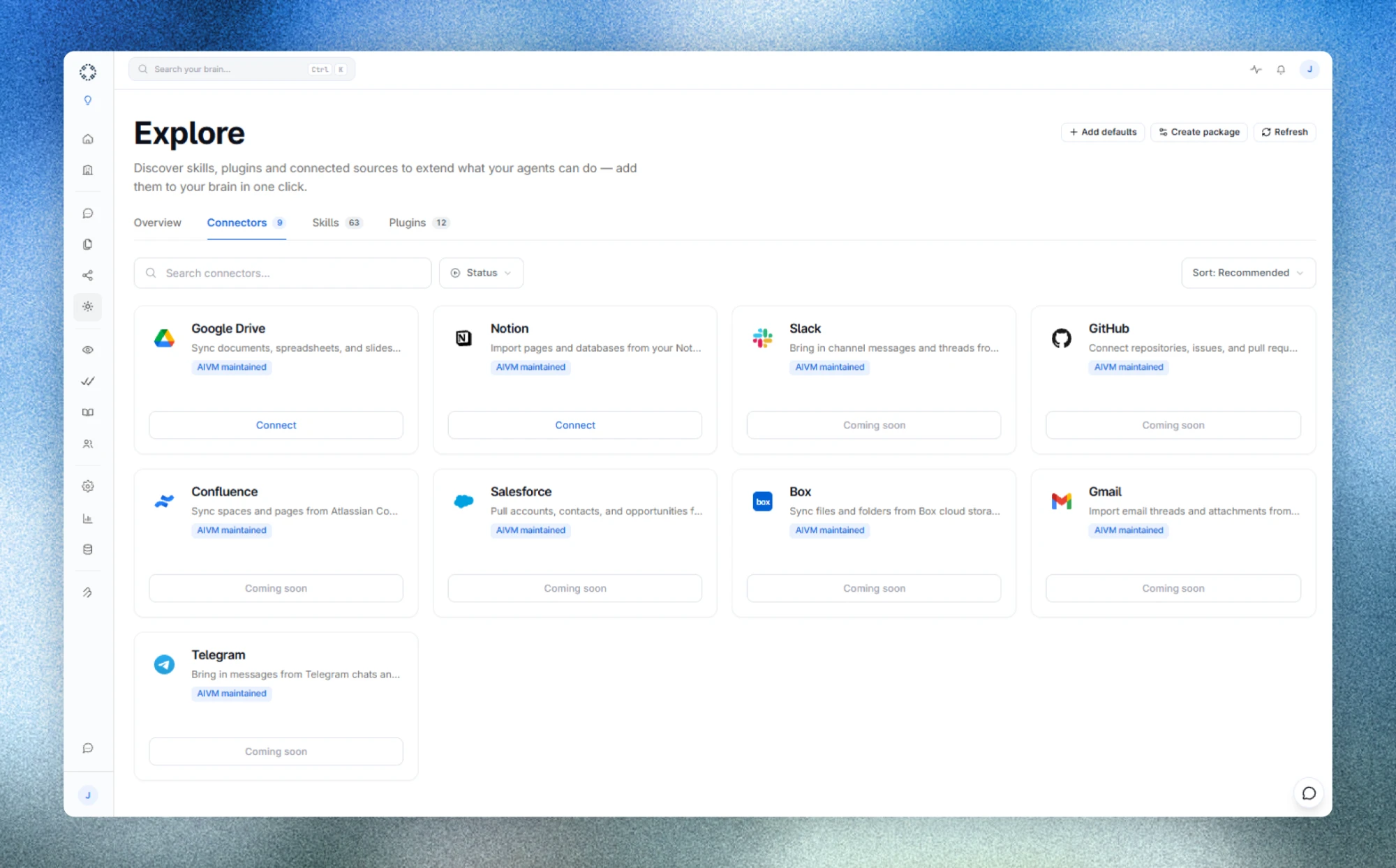
Connect the sources supported in your workspace and add files directly. Google Drive and Notion are shown as connectable in the launch catalogue below; Slack, GitHub, Salesforce, Confluence, Box, Gmail and Telegram are shown as coming soon. Check the current connector catalogue for availability before planning a rollout.
Context stops being something people reconstruct in a prompt window and becomes something the organisation holds.
Permissions enforced at retrieval
This is where company AI gets difficult. The goal is to make more company knowledge usable without making more company knowledge universally visible. Most tooling resolves that tension by quietly choosing one.
Brain evaluates identity and permissions as part of retrieval itself. Different people and different AI systems work from the same Brain and receive different context. Privacy and permission management are designed into the retrieval path rather than layered on top of it.
Brain also records governed access, so organisations can see who requested information, which sources were involved, and which access rules applied. We call the broader idea the Lineage of an Answer.
AI becomes much more useful when it understands the company. It becomes deployable when the company can still control what it understands for each user.
A live knowledge graph
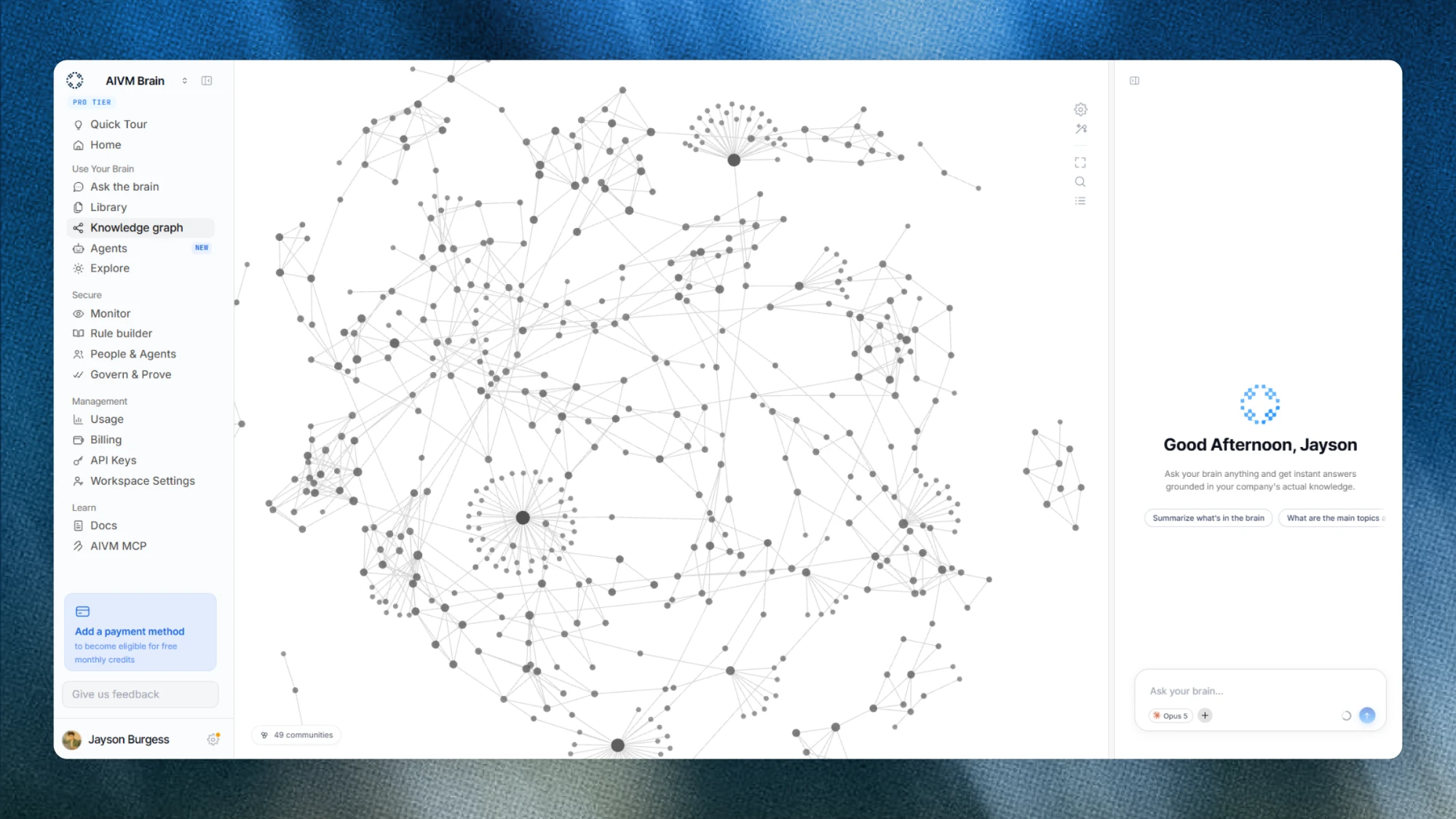
As more context enters Brain, the knowledge graph gives teams a visual representation of how that information connects. Documents, people, projects, topics, and decisions stop looking like isolated files and start forming a map of the organisation's knowledge.
The graph is obviously fun to look at. The useful part is that those relationships become part of the context Brain works with, rather than treating every piece of information as an unrelated chunk.
Usage monitoring across people, agents, and models
Once AI becomes multiplayer, usage becomes harder to understand. Employees use different models. Agents run workflows independently. API keys power automations. Costs accumulate across the organisation, often without a single owner.
Brain gives teams one place to monitor AI usage across people, agents, models, API keys, and workflows. As AI becomes infrastructure, spend visibility becomes part of the control layer.
Enterprise Control
Brain is built for organisations that need to deploy AI without surrendering control of what it can see.
- Governed retrieval. Identity and permissions are evaluated as part of every retrieval, not applied as a filter afterwards.
- Granular access rules. Define access by person, role, department, group, or agent, with scoped knowledge regions and effective dates.
- Agents under the same rules as people. An agent receives its own governed access rather than inheriting a human's credentials.
- Auditability. Governed access is recorded, so you can reconstruct who requested what, from which sources, under which rules.
- Usage and spend visibility. Consumption tracked across members, agents, models, API keys, and workflows.
- Custom deployment support. For larger organisations, we work directly with teams on customised integrations, permission structures, governance requirements, and deployment.
Companies did not lose control of their data through carelessness. They connected AI to systems whose permissions were designed for humans, and discovered too late what the machine could reach. Brain gives an organisation one governed source of truth that people and agents share, where every connection, permission, and retrieval is scoped and recorded.
Getting Started
Building your first Brain takes minutes.
- Connect your AI. Choose the environment you already work in, Claude Desktop, Claude Code, Cursor, or Codex, and connect it to your workspace.
- Connect your company tools. Add the sources holding the context your team already relies on.
- Add your existing knowledge. Upload documents, research, strategy, and project files that do not live inside a connected source.
- Invite your team. Everyone works from shared company intelligence under their own permissions.
- Give it real work. Ask about a live project. Query customer research. Find the latest approved context around a feature.
The fastest way to understand a Company Brain is to stop reading about one and actually use it.
Company Brain Is Now Open to Everyone
Company Brain is publicly available today. You can create a workspace, connect your knowledge, connect the AI tools you already use, invite your team, and start building for free.
→ Start building your Brain: Heybrain.io
For larger organisations that need customised integrations, permission structures, governance requirements, and deployment support, we work with teams directly.
The first era of generative AI gave individuals access to incredibly capable models. The next one is about making that intelligence work across the company.
Shared context. Different permissions. Multiple people. Multiple AI systems.
One Brain.