

Cognee vs Mem0: Which one does your agent need?
Pick Cognee if your agent needs a knowledge graph built from documents, code and conversations that you can run yourself, even without an LLM key. Pick Mem0 if it needs to remember what each user and agent said, as a library, a server or a hosted service. Cognee and Mem0's library and server are open source under Apache 2.0, and both work with AI tools over MCP (Model Context Protocol, an open standard that lets AI tools call outside services).
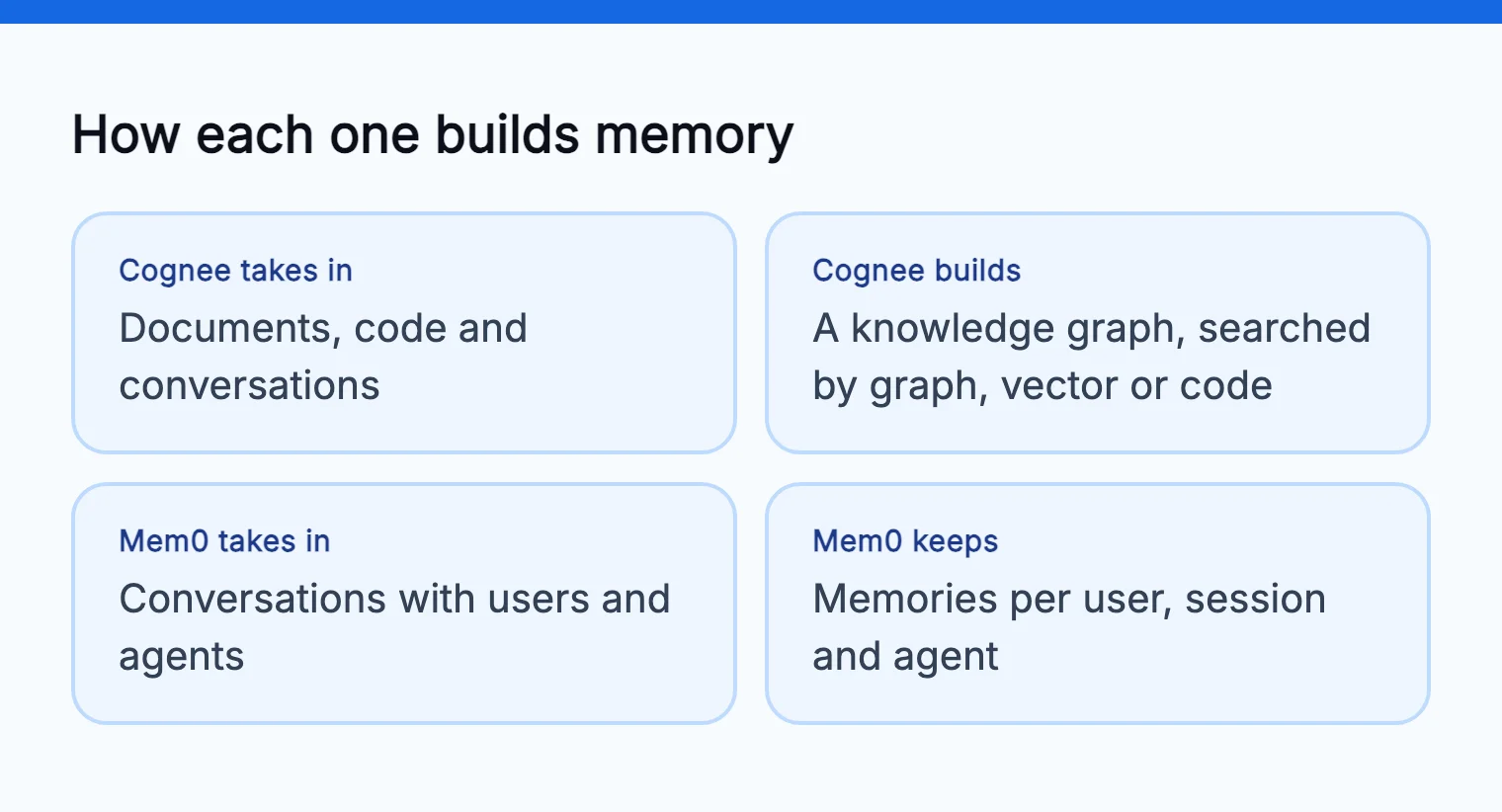
- Cognee turns documents, code and conversations into a self-hosted knowledge graph and runs locally with small models.
- Mem0 extracts memories from conversations and keeps them per user, session and agent.
- Both have hosted versions: Cognee Cloud, priced by tokens, and the Mem0 Platform, with a free plan.
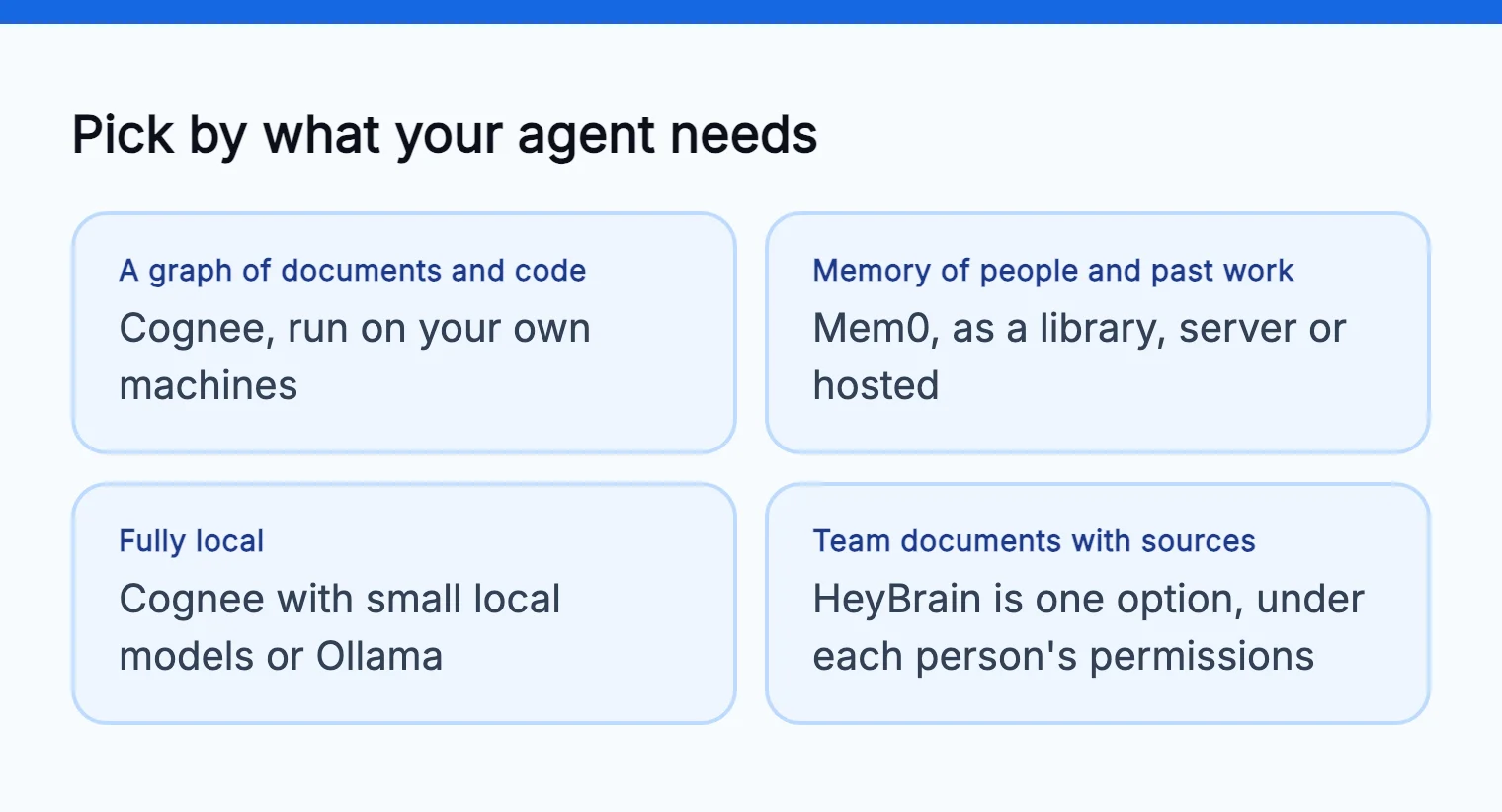
- If you want your team's documents answered with sources under each person's permissions, HeyBrain is one knowledge layer you can add.
Contents

Cognee vs Mem0
Knowledge graph or memory layer
How do Cognee and Mem0 compare?
Cognee and Mem0 are both open-source memory for AI agents, licensed Apache 2.0, but they remember different things. Cognee builds a knowledge graph from documents, code and conversations. Mem0 extracts memories from conversations and keeps them per user, session and agent. Each is described from its own pages and repository, checked on November 24, 2026.
| Cognee | Mem0 | |
|---|---|---|
| Made by | The Cognee team, whose repository sits under the topoteretes organization on GitHub | Mem0, a Y Combinator S24 company |
| Approach | Turns documents, code and conversations into a knowledge graph, then retrieves graph, vector or code context | Extracts memories from conversations, links the entities in them and keeps them per user, session and agent |
| Open source | Yes, Apache 2.0; runs locally with small models and no API key | Yes, Apache 2.0, for the library and the self-hosted server |
| Hosting | Self-hosted with Docker Compose, or Cognee Cloud; Enterprise as bring-your-own-cloud | The Python or npm library, a self-hosted server, or the hosted Mem0 Platform, a separate managed service; on-premises on the Custom plan |
| Best for | A knowledge graph of your documents, code and conversations that you run yourself | Memory of what users and agents said, as a library, a server or a hosted service |
| Pricing model | Cloud Standard $0 a month with 100 million tokens, then $0.10 per million; Premium $99 a month plus tokens; Enterprise on request | A free plan with monthly limits on adds and retrievals, with model calls covered for the first 30 days and your own LLM key after that; a Custom plan on request |
How does Cognee build memory?
Cognee builds memory by turning what you give it into a connected graph. Text becomes entities, relationships and searchable chunks, and code becomes a graph of symbols and dependencies. At question time it picks graph, vector or code context, and your app can inspect the evidence it retrieved before using it in an answer or an agent task.
Its four operations are remember, recall, improve and forget. Cognee runs locally with small models and no API key, and adding an LLM key gives generated answers. It has Python, TypeScript and Rust SDKs, a REST API, an MCP server and plugins for Claude Code, Codex and OpenClaw. The Cognee repository has the quickstart.
When should you pick Cognee?
Pick Cognee when your agent needs to reason over documents and code, not only conversations, and you want the result as a graph of entities and relationships. It also fits when everything must run on your own machines: it works locally with small models and no API key (Cognee calls the bundled extractor a demo), or with local Ollama models for generated answers. It supports custom ontologies too.
Cognee publishes BEAM results that compare it with Mem0 and other memory tools. Like every vendor's benchmark, treat it as a claim to test on your own data. For a side-by-side with HeyBrain, see HeyBrain vs Cognee.
When should you pick Mem0?
Pick Mem0 when your agent needs to remember people and its own work across conversations: preferences, earlier answers and what it did. Mem0 keeps memory per user, session and agent, installs as a library with pip or npm, and also runs as a self-hosted server or the hosted Mem0 Platform with an MCP server for Claude, Cursor and Codex.
Its extraction adds new memories rather than overwriting old ones, and the hosted Platform supersedes outdated facts. The Mem0 repository covers all three ways to run it. For Mem0 against Zep's hosted context graphs, see Mem0 vs Zep, and for a side-by-side with HeyBrain, see how HeyBrain compares with Mem0.
Where does company knowledge fit?
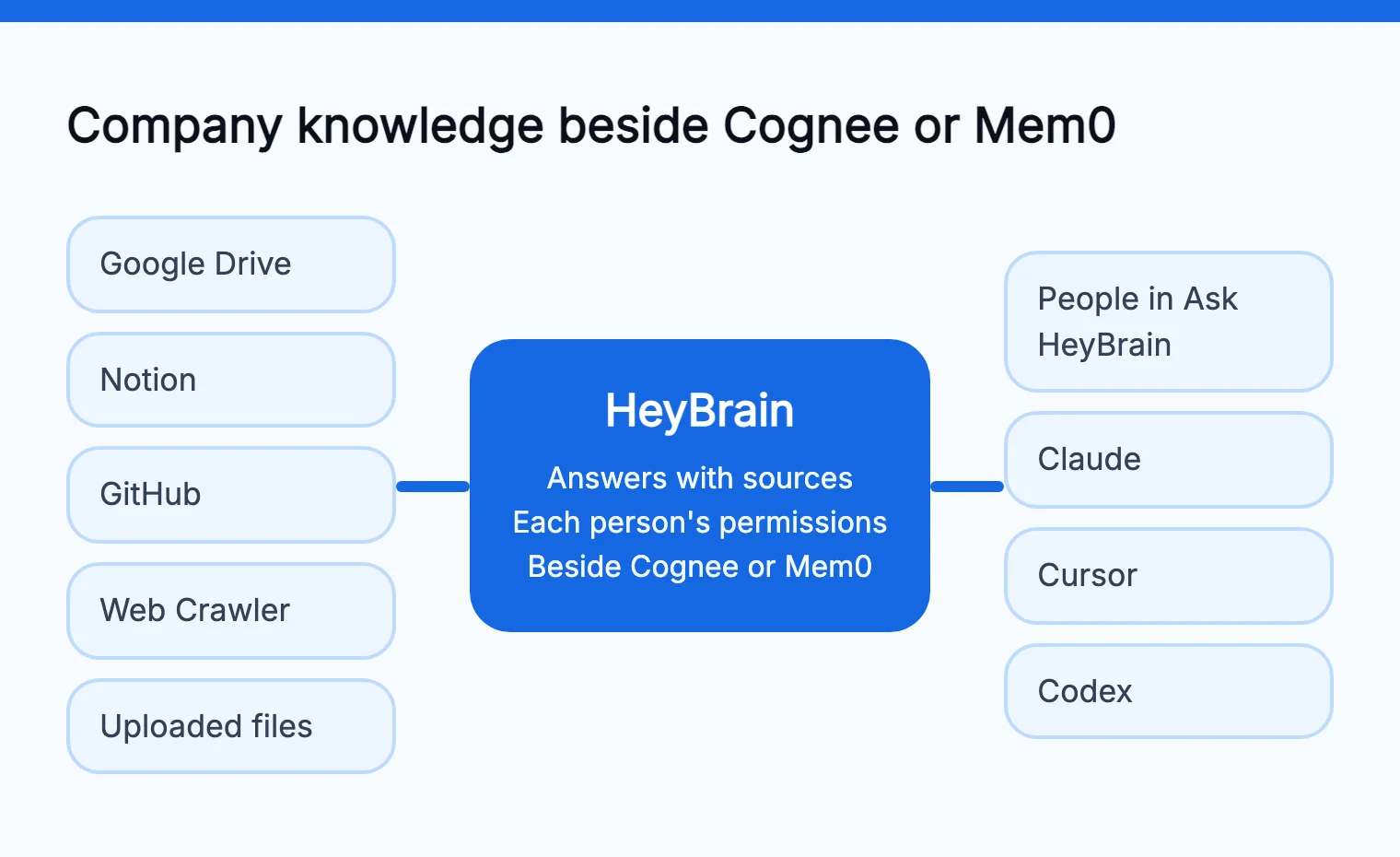
Cognee can also bring in team sources such as Google Drive, Notion and Slack, and Mem0 holds what users and agents said. HeyBrain is one option built for a team's shared documents: it connects the tools a team already uses, such as Google Drive, Notion and GitHub, and answers people in Ask HeyBrain and AI tools such as Claude, Cursor and Codex with sources, within the permissions you set.
Frequently asked questions
What is Cognee?
Cognee is an open-source AI memory platform for agents, licensed Apache 2.0. It turns documents, code and conversations into a self-hosted knowledge graph that agents can search, and it runs locally with small models and no API key. Adding an LLM key gives generated answers, and Cognee Cloud offers a hosted version.
Is Cognee a knowledge graph?
Cognee builds one. It extracts entities and relationships from text into a knowledge graph, turns code into a graph of symbols and dependencies, and keeps searchable chunks alongside them. At question time it picks graph, vector or code context, so it works as both a memory layer and a retrieval engine for your agent.
Cognee or Mem0 for RAG?
For retrieval over documents and code, Cognee fits more naturally: it ingests them into a graph and returns graph, vector or code context that your app can inspect. Mem0 is built around memory of conversations, kept per user, session and agent. For questions over a team's shared documents under each person's permissions, HeyBrain is one option built for that job.
Are both open source?
Yes. Cognee and Mem0 are both licensed Apache 2.0, and both run on your own infrastructure. Each also offers a hosted service: Cognee Cloud, with a free Standard plan priced by tokens, and the Mem0 Platform, a separate managed service with a free plan limited by monthly adds and retrievals and a Custom plan on request.
Can I use Cognee and Mem0 together?
Yes. Cognee's README shows importing memory from Mem0, Letta, Zep or Graphiti through its COGX exchange format, so you can move memory from Mem0 into Cognee. You could keep Mem0 for what each user said and Cognee for a graph of documents and code, but two memory systems mean two things to run, so start with one.
The short version
Pick Cognee for a knowledge graph of documents, code and conversations that you run yourself, and Mem0 for memory of what users and agents said. If your team also wants its own documents answered with sources under each person's permissions, HeyBrain is one option to add. Our overview of agent memory layers compared covers more options.